

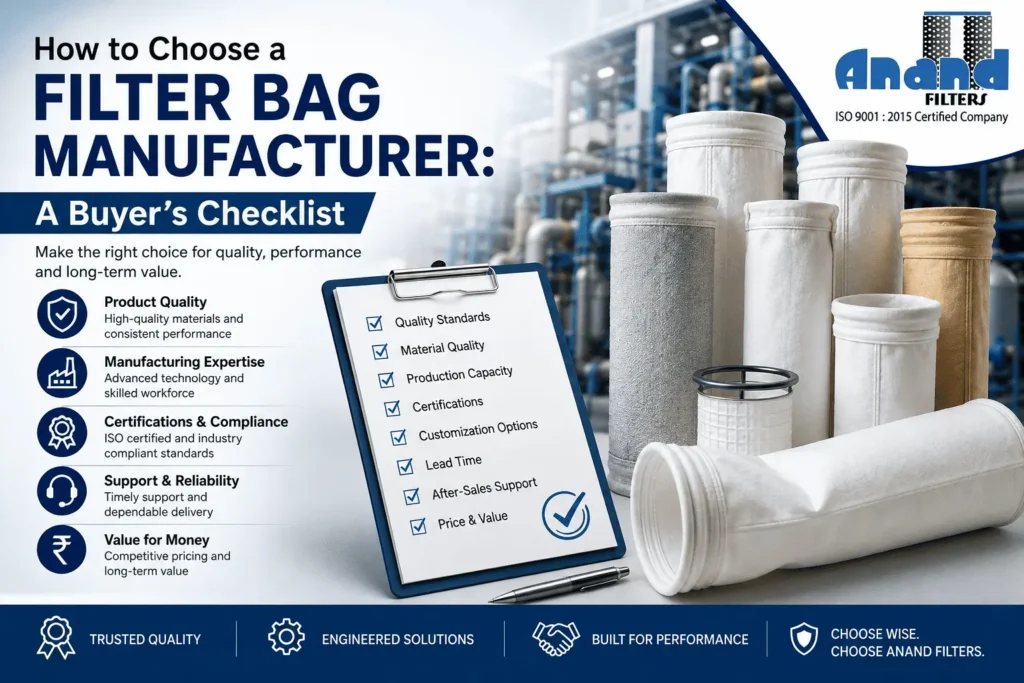
How to Choose a Filter Bag Manufacturer: A Buyer’s Checklist
Every dust collection system depends on one relatively unglamorous component doing its job perfectly, cycle after cycle: the filter bag. Get the bag specification and the manufacturer both right, and your pulse-jet dust collector runs quietly for months with predictable pressure drop. Get either one wrong, and you’re looking at premature blinding, torn seams, non-compliant emissions readings, or a plant floor full of dust that should have been captured.
Choosing a filter bag manufacturer is not the same exercise as comparing prices on a product listing. Two suppliers can quote what looks like an identical bag — same dimensions, same stated micron rating — and deliver very different real-world performance because of differences in fabric weight, needle-punch density, seam construction, and quality control. This guide gives you a practical, checklist-driven way to evaluate filter bag suppliers before you commit to an order, so you’re buying on verifiable specification rather than a spec sheet claim.
Know Your Application Before You Shortlist Manufacturers
The single biggest mistake buyers make is starting the manufacturer search before nailing down what the bag actually needs to handle. Dust collector filter bags used in a cement plant face completely different demands than bags used in a chemical processing unit or a food-grade facility — and a manufacturer who is excellent for one application may not be the right fit for another.
Cement and mineral processing environments generate abrasive, high-volume dust loads that demand heavier-weight, abrasion-resistant fabric. Cement industry dust collection typically calls for polyester or aramid-blend bags built to withstand continuous mechanical stress. Ceramics manufacturing introduces fine, often high-temperature particulate that requires closer attention to thermal rating — see how this plays out in filtration for the ceramics industry. Steel and foundry operations bring their own combination of high temperature and coarse particulate, covered in more detail under steel industry filtration solutions.
Before contacting any manufacturer, be ready to answer: what is the dust composition and particle size distribution, what is the operating temperature range, is there moisture or oil mist in the airstream, and what emissions standard does the outlet need to meet? A manufacturer worth working with will ask you these questions before recommending a bag — if a supplier quotes a price without asking about your application, treat that as an early warning sign rather than efficiency.
Filter Bag Materials: What a Good Manufacturer Should Offer
A capable filter bag manufacturer should be able to talk you through material options in plain terms, not just hand you a datasheet. The core distinction to understand first is woven versus non-woven construction. Woven fabric bags are made from tightly interlaced yarns and rely on a dust cake building up on the surface to achieve full efficiency — they’re durable and cost-effective for coarser applications but take longer to reach peak filtration performance after cleaning. Non-woven filter bag media, by contrast, is made from randomly oriented fibres bonded together (typically by needle-punching), giving it a denser, more three-dimensional structure that captures finer particles immediately, without waiting for a dust cake to form.
Beyond weave type, fibre chemistry determines what conditions a bag can actually survive. Polyester remains the workhorse for general-purpose dust collection up to moderate temperatures. Aramid fibres (like Nomex) hold up in significantly higher-temperature environments and resist chemical attack better than polyester. PTFE-membrane and PTFE-laminated bags add a thin, highly efficient surface layer that improves fine-particle capture and resists moisture and sticky dust far better than standard media — increasingly common in demanding applications. A manufacturer worth shortlisting should be actively working with these newer material grades, not offering polyester as the only option regardless of application.
The Buyer’s Checklist: What to Verify Before You Order
Use the table below during supplier evaluation calls or plant visits. Each item is something you should be able to get a direct, specific answer to — vague or evasive responses on any of these are worth flagging.
| Checklist item | Why it matters | Red flag response |
|---|---|---|
| ISO / quality certification | Confirms a documented, audited quality management system, not just a claim | Can’t produce a valid certificate on request |
| Material traceability | Ensures the fabric batch matches what was specified, especially for aramid/PTFE grades | No batch records or fabric source documentation |
| Stated micron rating with test data | A real filter bag micron rating should come with efficiency test data, not just a number | Micron figure with no supporting test method |
| Seam and stitching quality | Most bag failures start at seams, not the fabric itself | Visible loose stitching or single-pass seams on samples |
| Temperature resistance rating | Must match your actual operating temperature, including short-term spikes | Generic rating not specific to the fibre used |
| Customization capability | Non-standard cage sizes, snap-band tops, and bag lengths are common in retrofits | Only offers a fixed catalogue of standard sizes |
| Lead time and stock availability | Determines how fast you can respond to unplanned bag failures | No clear lead-time commitment in writing |
| Technical/after-sales support | A good manufacturer helps you troubleshoot pressure-drop issues, not just ship product | No engineering contact beyond a sales rep |
Filter Bag Manufacturer vs Filter Bag Trader: Know the Difference
Not every business selling filter bags actually manufactures them. Many are traders or resellers sourcing from third-party mills and adding a margin — which isn’t necessarily a problem, but it does change what you should expect in terms of customization, technical support, and accountability if something goes wrong.
| Factor | Filter Bag Manufacturer | Filter Bag Trader / Reseller |
|---|---|---|
| Customization | Can adjust fabric weight, stitching, cage fit | Limited to what’s already produced |
| Technical support | In-house engineering can troubleshoot application issues | Usually passes queries back to the manufacturer |
| Lead time control | Direct control over production scheduling | Dependent on upstream supplier’s schedule |
| Price for standard sizes | Competitive, sometimes higher for small orders | Can be lower for standard catalogue sizes |
| Accountability on quality issues | Direct — same company made the bag | Indirect — depends on their supplier relationship |
For standard, off-the-shelf bag sizes in low-risk applications, a reseller can be a perfectly reasonable choice. But for anything involving a demanding application, a non-standard housing, or a recurring performance problem you’re trying to solve, working directly with a manufacturer gives you far more room to actually fix the underlying issue rather than just reordering the same bag that already isn’t performing.
Questions to Ask Before You Finalize a Supplier
Beyond the checklist, a short conversation can reveal a lot about how a manufacturer actually operates. Ask directly: what fabric weight (in GSM) do you recommend for my dust load and why; can you supply a small trial batch before a full production order; what’s your typical bag lifespan for an application similar to mine, and how do you define end-of-life; and what happens if a batch doesn’t meet the agreed specification on inspection. A manufacturer who answers these with specifics, rather than general reassurance, is one worth taking seriously.
It’s also worth understanding how the bags fit into your broader dust collection system. If you’re deciding between bag-style and cartridge-style filtration for a new or upgraded system, it helps to compare both approaches directly rather than assuming one is universally better.
Common Mistakes Buyers Make When Selecting a Filter Bag Manufacturer
- Buying on price per bag alone. A cheaper bag that fails at half the service life, or blinds and raises energy consumption, almost always costs more over a year than a correctly specified one.
- Not requesting a sample before a full order. Fabric weight, stitching quality, and finish are things you should physically inspect, not just take on a spec sheet’s word.
- Ignoring the cleaning method mismatch. A bag built for shaker-type cleaning won’t necessarily perform well in a pulse-jet system, and vice versa — confirm the bag is designed for your specific cleaning mechanism.
- Assuming all “non-woven” bags are equivalent. GSM (fabric weight), needle-punch density, and finishing treatment vary significantly between manufacturers even at the same nominal micron rating.
- Not asking how bag condition should be monitored. Knowing when to clean versus replace a bag prevents both premature replacement costs and unexpected mid-cycle failures.
Filter bags themselves are one part of a larger housing system. If you’re building out or upgrading a dust collector from scratch, it’s worth reviewing the fundamentals of the equipment itself alongside your bag specification — a well-matched system explained in more depth in this buying guide for industrial dust collectors in India. And if you’re weighing manufacturers by location, our buyer’s guide to industrial filter manufacturers in Ahmedabad is a useful companion read.
For readers who want a deeper technical grounding on how dust collection systems work as a whole — including baghouse design principles that inform how filter bags are engineered — Wikipedia’s overview of baghouse filtration systems is a solid general reference.
Why Plants Choose Anand Filters as Their Filter Bag Manufacturer
Anand Filters manufactures non-woven filter bags and complementary dust collector cartridges in-house from GIDC Vatwa, Ahmedabad — not through a third-party trading arrangement — which means direct control over fabric sourcing, stitching quality, and customization.
- Polyester, aramid, and PTFE-laminated material options matched to your application
- Full material traceability and batch documentation on request
- Custom cage sizes, snap-band, and bag-top configurations for retrofit projects
- ISO 9001:2015 certified manufacturing with in-house technical support
Get a Filter Bag Specification Built for Your Application
Share your dust type, temperature range, and cleaning system — our engineering team will recommend the right material and micron rating before you order, not after.
Frequently Asked Questions
Conclusion
Choosing a filter bag manufacturer is really two decisions bundled into one: getting the right material and micron rating specified for your application, and finding a supplier who can back that specification with verifiable quality, traceability, and support. The checklist and comparison tables in this guide give you a concrete way to evaluate suppliers on substance rather than a price quote alone — the difference shows up in fewer unplanned shutdowns and more predictable filtration performance over the life of your dust collection system.
For help specifying and sourcing the right filter bag for your plant, contact Anand Filters — ISO 9001:2015 certified manufacturer, 22+ years at GIDC Vatwa, Ahmedabad.