

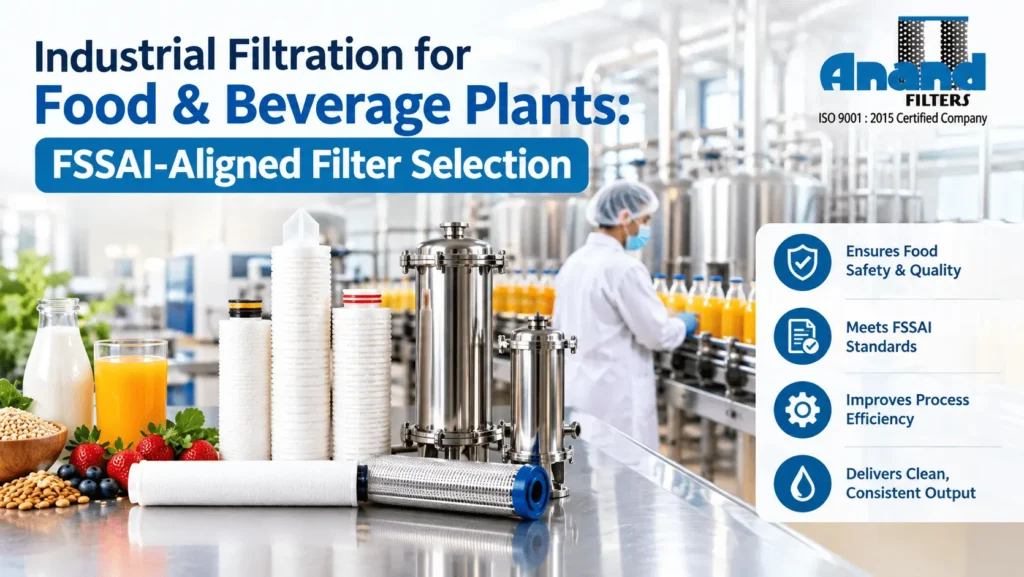
Industrial Filtration for Food & Beverage Plants: FSSAI-Aligned Filter Selection
Industrial filtration for food and beverage plants carries a weight that general manufacturing filtration doesn’t: get it wrong, and the consequence isn’t just downtime, it’s product safety and regulatory compliance. A filter material that’s perfectly acceptable in a cement plant or a machine shop can be a genuine liability in a dairy line or a bottling facility, where every surface in contact with product or process air has to meet food-safety expectations, not just mechanical ones.
This guide walks through what actually changes when filtration moves into a food-grade context — the material requirements, the compressed air quality standards, and the practical checklist you need to work through before specifying filters for a food or beverage production line. The goal is FSSAI-compliant filters and hygienic design choices that hold up under audit, not just filters that happen to work.
Why Food & Beverage Filtration Has Different Rules Than General Industrial Filtration
General industrial filtration is optimized around efficiency, pressure drop, and service life. Food grade filtration in India has to satisfy those same performance criteria while also meeting a second, independent set of requirements: does the filter material itself pose any contamination risk to the product, and can the entire filtration assembly be cleaned to the standard the process demands?
The Food Safety and Standards Authority of India (FSSAI) doesn’t publish a filter-specific product standard the way, say, a pressure vessel code does. Instead, its hygiene and food safety requirements set expectations that filtration equipment has to be engineered to satisfy — food-contact material safety, and process design that supports cleaning and sanitation without harbouring contamination. This is where hygienic filter design becomes a real engineering consideration rather than a marketing phrase: smooth internal surfaces without crevices where product or moisture can collect, materials that tolerate repeated cleaning cycles without degrading, and construction that avoids trapping contamination between components.
For readers who want the regulatory background in more depth, Wikipedia’s overview of the Food Safety and Standards Authority of India is a useful general reference on FSSAI’s role and mandate. For the authority’s own mandate, functions, and current regulations, see the official FSSAI organisation page directly.
Where Filtration Is Applied Across a Food & Beverage Plant
Filtration touches more points in a food or beverage plant than most people initially assume — it’s rarely just one filter on one line. Understanding where each type applies helps you specify correctly rather than treating the whole plant as a single generic filtration problem.
- Incoming water treatment before it enters production
- Dairy processing filters for milk and liquid product lines
- CIP (clean-in-place) compatible housings and seals
- Food-contact stainless steel throughout wetted parts
- Oil-free or verified low-oil compressed air for pneumatic conveying
- Dust collection for flour, milk powder, and sugar handling
- HEPA filtration for packaging-area cleanroom zones
- Panel pre-filters protecting HVAC in production areas
For plants running dairy or beverage production lines, it’s worth reviewing your filtration needs application by application rather than product by product — our dairy, food and beverages application page covers the specific filter categories we supply for this sector in more detail. On the powder-handling side, dust collector cartridges rated for food-grade environments prevent fine powder contamination from escaping into the plant atmosphere, which matters both for product yield and for housekeeping compliance during inspections.
Filter Materials That Meet FSSAI-Aligned Requirements
Material selection is where general industrial filtration and food-grade filtration diverge most clearly. A material that’s mechanically sound isn’t automatically food-safe — chemical compatibility, corrosion resistance under repeated washdown, and cleanability all factor into whether a material is actually appropriate for a food-contact or near-product application.
| Material | Typical use in F&B | Why it’s relevant to compliance | Cleaning compatibility |
|---|---|---|---|
| 304 stainless steel | General process equipment, non-aggressive product contact | Corrosion-resistant, widely accepted food-contact grade | Good — tolerates standard CIP cycles |
| 316 stainless steel | High-salinity or acidic product lines, aggressive cleaning agents | Superior corrosion resistance vs 304 under harsher conditions | Excellent — holds up to more frequent, aggressive CIP |
| Food-grade elastomers (FDA/EU-compliant) | Gaskets, seals, O-rings in product-contact assemblies | Standard NBR/rubber seals may leach compounds — food-grade grades are formulated to avoid this | Depends on grade — verify temperature and chemical rating |
| HEPA glass fibre media (H13–H14) | Packaging area air handling, cleanroom-adjacent zones | Prevents airborne contamination in controlled packaging environments | Not washable — scheduled replacement and integrity testing instead |
| Food-grade polyester/non-woven media | Compressed air filtration, dust collection | Non-shedding, compatible with food-processing air quality needs | Element replacement rather than cleaning |
It’s worth being specific here: not every stainless steel filter housing on the market is automatically food-grade just because it’s stainless steel. Surface finish, weld quality, and whether the grade has been properly specified for food contact all matter. Our stainless steel filter range is built with this distinction in mind rather than treating “stainless steel” as a single generic spec.
Compressed Air Quality Standards for Food & Beverage Production
Compressed air is one of the most overlooked contamination pathways in food and beverage plants, largely because it’s invisible. Air used for pneumatic conveying, product blow-off, or direct product contact (in some packaging processes) needs to meet a defined air quality class, not just “look clean.” ISO 8573-1, the international standard for compressed air contaminants and purity, defines air quality classes based on particulate, water, and oil content, and food-contact applications generally need to target the strictest classes on the oil content scale — Class 0 or Class 1 — since even trace oil carryover is a genuine contamination risk in a food-contact context.
This is where the oil-free versus oil-injected compressor decision becomes directly relevant to compliance, not just an operating-cost question. Oil-injected compressors can still deliver acceptable air quality with correctly specified compressor filtration and coalescing stages, but the filtration has to be verified and monitored, not assumed. We’ve covered this trade-off in more depth, including where each compressor type fits, in Filter for Compressor Systems: Oil-Free vs Oil-Injected Separator Technology.
A Practical Filter Selection Checklist for F&B Plants
| Process stage | Contamination risk | Recommended filter type | Material requirement |
|---|---|---|---|
| Incoming process water | Sediment, biological contamination | Cartridge or bag filtration, sized to water quality | Food-grade housing and media |
| Dairy/liquid product line | Particulate, microbial contamination | Inline cartridge filters, CIP-compatible | 304/316 stainless steel housing |
| Pneumatic conveying air | Oil carryover, particulate | Coalescing + particulate compressor filters | Food-grade filter media, verified oil-free rating |
| Powder handling (flour, sugar, milk powder) | Fine dust escape, cross-contamination | Dust collector cartridges, food-grade rated | Non-shedding polyester or PTFE-laminated media |
| Packaging area air handling | Airborne particulate, microbial load | HEPA (H13/H14) with panel pre-filtration | Sealed frame construction, integrity-testable |
Common Compliance Mistakes in Food & Beverage Filtration
- Using industrial-grade seals to save cost. Standard NBR or generic rubber gaskets can leach compounds under repeated cleaning and heat exposure — food-grade elastomer specifications exist precisely to rule this risk out.
- Skipping filter integrity testing before audits. HEPA filters in packaging areas need documented integrity testing, not just a visual check, to hold up under FSSAI or customer audit scrutiny.
- Treating compressed air as “clean enough” without verification. Air quality should be measured against a defined ISO 8573-1 class, not assumed based on compressor type alone.
- Overlooking cleanability in housing design. A filter housing with crevices or hard-to-reach internal surfaces undermines CIP effectiveness regardless of how good the filter media itself is.
Why Work With a Certified Manufacturer for Food-Grade Filtration
Food and beverage plants carry compliance risk that general manufacturing doesn’t, which makes the choice of food and beverage filter manufacturer a genuine due-diligence question, not just a procurement one. As a certified industrial filter manufacturer, Anand Filters manufactures in-house from GIDC Vatwa, Ahmedabad, with full material traceability and documented quality systems — the kind of paper trail that matters when a customer or regulator asks where your filtration components came from and what they’re made of.
- ISO 9001:2015 certified manufacturing with documented quality systems
- Food-grade stainless steel and polyester media options across product lines
- HEPA and panel filtration for packaging-area air handling
- 22+ years serving regulated industries — see more about our manufacturing background and the industries we serve across India
Get a Filtration Compliance Review for Your Plant
Share your process stages and current filtration setup — our engineering team will help you identify gaps against FSSAI-aligned material and air quality expectations.
Frequently Asked Questions
Getting filtration right in a food and beverage plant is a compliance decision as much as an engineering one. Material selection, compressed air quality, and hygienic design all need to be verified against FSSAI-aligned expectations rather than assumed from a general industrial filtration spec sheet. The checklist and material comparisons in this guide give you a practical starting point for that evaluation.
For help specifying FSSAI-compliant filters for your dairy, beverage, or food processing line, contact Anand Filters — ISO 9001:2015 certified manufacturer, 22+ years at GIDC Vatwa, Ahmedabad.