

What is a Suction Strainer? Function, Sizing and Selection Guide for Industrial Pumps
A pump running without a suction strainer is one of the most common — and most preventable — causes of industrial pump failure. Solid particles, rust, pipe scale, and debris entering the pump inlet cause impeller erosion, seal damage, and bearing failure that can cost lakhs in unplanned downtime. A properly selected suction strainer for pumps stops contamination before it ever reaches the pump.
This guide covers everything engineers and procurement teams need to know: what a suction strainer is, how it works, which type suits your application, how to size one correctly, and what to look for when choosing a suction strainer manufacturer in India.
What is a Suction Strainer?
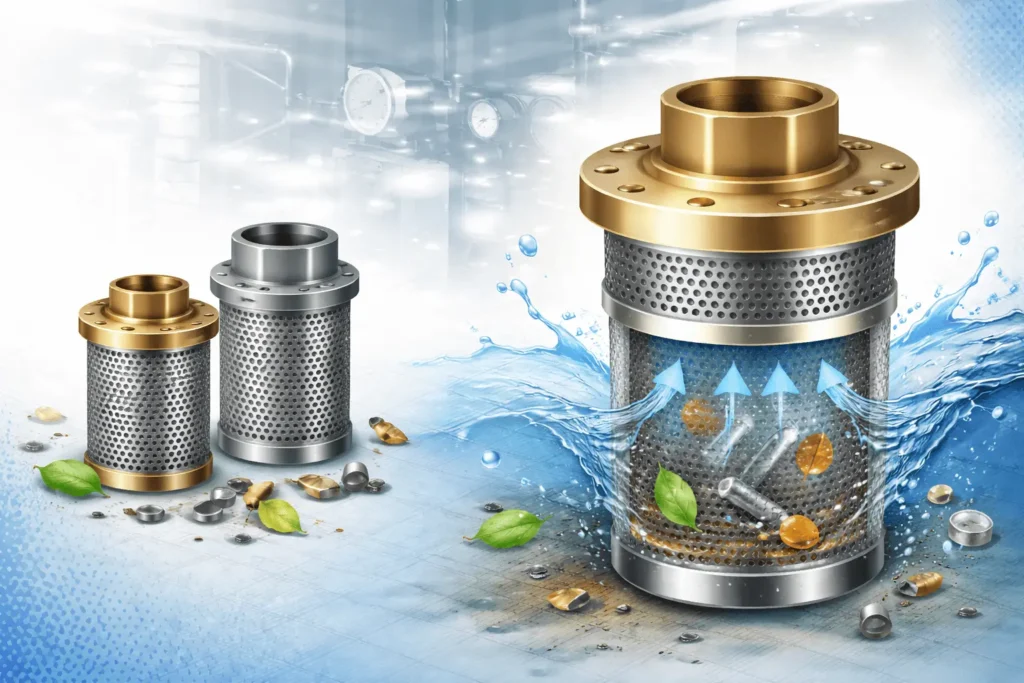
A suction strainer is a mechanical filtration device installed on the inlet (suction side) of a pump to prevent solid particles, debris, and foreign matter from entering and damaging pump internals. It consists of a perforated or woven mesh screen housed inside a valve body, positioned between the fluid source and the pump inlet connection.
Unlike a discharge filter — which is installed after the pump — a suction strainer works upstream, protecting the pump itself. It is the first line of defence in any pump protection strategy.
Key technical facts:
- Installed position: suction side of pump, before the pump inlet flange
- Filtration mechanism: woven wire mesh or perforated plate
- Typical mesh range: 60 micron to 1,500 micron depending on application
- Body materials: stainless steel (SS304, SS316), carbon steel, cast iron
- Connection types: flanged, threaded (BSP/NPT), wafer
A suction strainer is not the same as a suction filter. A strainer captures larger particles using a rigid screen and can be cleaned and reused. A filter uses a filter medium to remove finer contamination and typically requires element replacement rather than cleaning.
How Does a Pump Suction Strainer Work?
The operating principle of a pump suction strainer is straightforward but critical to understand for correct maintenance and sizing.
- Fluid enters the strainer body through the inlet connection from the tank, sump, or pipeline.
- Flow passes through the mesh screen, which allows clean fluid to pass while retaining solid particles larger than the mesh opening.
- Clean fluid exits through the outlet connection and flows into the pump inlet.
- Retained particles accumulate on the upstream face of the screen, gradually reducing the effective open area.
- Pressure differential increases as the screen clogs. The difference in pressure between inlet and outlet is the key indicator of strainer condition.
- Bypass valve activates (in protected designs) when it exceeds a set threshold, allowing unfiltered flow to pass rather than starving the pump — though this means contaminated fluid can reach the pump.
A differential pressure (DP) indicator fitted across the strainer gives real-time visibility of screen condition. When rises above 0.5 — 0.7 bar on a clean-service strainer, it is time to clean or replace the element.
A hydraulic suction strainer operates on the same principle but is specifically engineered for hydraulic oil systems, where fine contamination control (ISO 4406 cleanliness codes) is critical to protecting proportional valves, cylinders, and hydraulic motors.
Types of Suction Strainers for Industrial Pumps
Choosing the right type of suction strainer depends on your pipe size, fluid type, flow rate, and how frequently you can take the system offline for maintenance.
Basket Strainers (T-Type and Y-Type)
The most widely used design. The strainer basket or cartridge sits inside a T-shaped or Y-shaped body and is removed from the bottom or side for cleaning.
- T-type basket strainers: large basket volume, low pressure drop, easy bottom-access cleaning. Best for high-flow centrifugal pump applications.
- Y-type strainers: compact, inline design with angled screen leg. Ideal where installation space is limited. Common on smaller pipe sizes (DN15–DN100).
- Best for: water, oils, process chemicals, cooling water systems
Cone Strainers (Temporary / Commissioning Strainers)
Conical woven mesh screens are inserted directly into the pipe bore, typically during system commissioning to catch weld slag, pipe scale, and construction debris. Low cost, disposable, not intended for permanent service.
- Best for: new pipeline commissioning, short-term protection before permanent strainers are installed
Hydraulic Suction Strainers
Designed specifically for hydraulic power unit (HPU) applications. Fitted inside the hydraulic tank at the pump suction port. Fine mesh (60–150 micron) prevents particle contamination that would damage proportional valves and actuators.
- Typically a submerged design — installed inside the hydraulic tank
- Must be sized to allow sufficient flow without excessive vacuum at pump inlet (cavitation risk)
- Best for: mobile hydraulics, industrial HPUs, press systems, CNC machinery
Foot Valves with Integral Strainers
Installed at the bottom of a suction pipe in an open sump, well, or tank. Combines a non-return (check) valve with a surrounding mesh screen. Prevents backflow when pump stops and keeps debris out of the suction line.
- Best for: submersible and end-suction pumps drawing from open tanks, bore wells, sewage sumps
Self-Cleaning Strainers (Automatic Backwash)
A motor-driven scraper or backwash mechanism continuously cleans the screen without shutting down the system. Best suited for processes that cannot tolerate downtime or where the fluid carries heavy solids.
- Best for: water treatment plants, cooling towers, paper mills, continuous chemical processes
Suction Strainer Sizing Guide: How to Choose the Right Size
Incorrect sizing is the most common cause of suction strainer problems. An undersized strainer creates excessive pressure drop that starves the pump and causes cavitation. An oversized strainer is a wasted cost. Use this suction strainer sizing guide to get it right.
The Three Core Sizing Parameters
1. Flow rate (m³/hr or LPM) The strainer must pass your maximum system flow rate with a clean-screen pressure drop of no more than 0.3–0.5 bar. Use the maximum continuous flow rate, not the average.
2. Free open area Industry standard: the total open area of the strainer screen should be a minimum of 3× to 5× the cross-sectional area of the connected pipe. This buffer accounts for partial clogging between maintenance intervals while keeping pressure drop acceptable.
3. Mesh / micron rating Select based on what you are protecting downstream:
Additional Sizing Considerations
- Fluid viscosity: high-viscosity fluids (oils, polymers) need a larger free area and coarser mesh to avoid excessive pressure drop.
- Fluid temperature: confirm body and seal material ratings match operating temperature — especially for hot water, steam condensate, and thermal oil systems.
- Solids loading: higher solids concentration means more frequent cleaning and may justify a self-cleaning or duplex strainer with a changeover valve.
- NPSH margin: on suction-lift applications, suction strainer pressure drop directly reduces available NPSH. Always verify net positive suction head (NPSHa) after accounting for strainer .
Where Are Suction Strainers Used? Key Industrial Applications
Suction strainers for pumps are used across virtually every process industry in India and globally. Key application sectors include:
- Chemical and petrochemical plants — protecting centrifugal and gear pumps handling acids, solvents, and process streams
- Oil and gas pipelines — upstream protection of metering pumps, injection pumps, and compressor skids
- Hydraulic power systems — hydraulic suction strainers on HPUs for presses, injection moulding machines, and material handling
- Water treatment plants — raw water intake filtration before dosing and filtration stages
- Steel and power plants — cooling water circuits, lubrication oil systems, condensate return lines
- Pharmaceutical manufacturing — WFI (water for injection) and process water system protection
- Food and beverage processing — hygienic stainless steel strainers on product and CIP lines
- Mining and mineral processing — slurry and process water pump protection
In each of these sectors, a correctly specified suction strainer extends pump maintenance intervals, reduces seal and impeller wear, and lowers total cost of ownership over the pump’s life cycle.
How to Select the Right Suction Strainer for Your Pump
Follow this six-step checklist when specifying a suction strainer for a new or replacement application.
Step 1 — Define your fluid Identify fluid type (water, oil, chemical, slurry), temperature range, viscosity (cP), pH, and corrosivity. This determines body material and seal selection.
Step 2 — Confirm flow parameters Record maximum flow rate (m³/hr), operating pressure (bar g), and allowable pressure drop across the strainer (typically ≤0.3–0.5 bar clean).
Step 3 — Match pipe connection Confirm pipe size (DN), pressure rating (PN10, PN16, PN40, ANSI Class 150/300), and end connection type — flanged, screwed BSP/NPT, or wafer for large-bore installations.
Step 4 — Select mesh rating Use the mesh selection table above. When in doubt between two ratings, select the coarser mesh — you can always upgrade later, but cavitation damage from a mesh that is too fine cannot be undone.
Step 5 — Choose body material
- SS316: corrosive chemicals, marine, pharmaceutical, food-grade
- SS304: general duty, mild chemicals, water
- Carbon steel: oil and gas, non-corrosive general service
- Cast iron: low-pressure water and non-corrosive cooling water
Step 6 — Consider maintenance access T-type basket strainers offer the easiest maintenance — the basket slides out from the bottom without disturbing pipework. Y-type strainers are compact but require more effort to clean. For critical or continuous service, specify a duplex strainer with changeover valve so one basket can be cleaned while the other remains in service.
Suction Strainer Maintenance: Cleaning, Inspection and Replacement
Even the best-specified strainer will fail prematurely without a structured maintenance programme.
Signs of a Clogged Suction Strainer
- Reduced pump flow rate or output pressure despite correct pump operation
- Increased pump noise or vibration — early signs of cavitation
- Rising pump motor current draw
- DP gauge reading above the clean-service baseline
- Pump running hot without a process-side reason
Cleaning Procedure (Basket Strainer)
- Isolate the strainer using upstream and downstream isolation valves
- Depressurise and drain the strainer body
- Remove the basket access cover or bottom plug
- Extract the basket — note orientation for refitting
- Flush the basket with clean water, compressed air, or solvent appropriate to the fluid
- Inspect mesh under light: look for holes, corrosion pitting, deformed basket frame
- Replace the basket if damaged — a mesh hole of even 2 mm renders the strainer useless
- Refit basket, close body, vent air, check for leaks before returning to service
When to Replace Rather Than Clean
Replace the strainer element — do not reinstall it — if you find any of the following:
- Mesh holes or tears, however small
- Deformation or collapse of the basket frame
- Corrosion pitting that compromises structural integrity
- Mesh opening enlarged through mechanical abrasion
Suction Strainer Manufacturers in India: What to Look for When Choosing a Supplier
India has a large number of strainer manufacturers, but quality varies significantly. Use this checklist when evaluating a suction strainer manufacturer for industrial procurement.
Material certification: insist on material test certificates (MTC) for all pressure-retaining parts. SS316 should be certified to ASTM A351 CF8M or equivalent. This matters especially for corrosive service and pharmaceutical applications.
Mesh quality: confirm whether mesh is welded-edge or raw-cut. Welded or bound edges prevent unravelling under flow pulsations — a failure mode common in cheap imported strainers.
Pressure and temperature ratings: the manufacturer should provide a documented pressure-temperature (P-T) rating table for each strainer size and body material.
Custom sizing capability: standard off-the-shelf strainers rarely fit every application. A capable manufacturer should be able to supply non-standard pipe sizes, special mesh ratings, and bespoke connection types without excessive lead time.
Replacement basket availability: confirm that replacement baskets are a stocked item. A strainer whose basket cannot be sourced within days is a maintenance liability.
Testing and inspection: reputable manufacturers hydrostatically test each strainer to 1.5× rated working pressure before dispatch.
Anand Filters manufactures a comprehensive range of industrial suction strainers — from DN15 Y-type strainers to DN300 basket strainers — for hydraulic, process, and water applications across India. All units are manufactured in SS304, SS316, and carbon steel with hydrostatic testing as standard.