

Suction Strainers vs Inline Filters: What’s the Difference and When to Use Each
If you’ve ever specified a hydraulic system and paused at the parts list wondering whether you need a suction strainer, an inline hydraulic filter, or both, you’re not alone. These two components are often used interchangeably in conversation, but they do very different jobs — and using the wrong one in the wrong place is one of the most common, and most expensive, mistakes in hydraulic system design and maintenance.
A misapplied suction filter can starve a pump and trigger cavitation within weeks. A system that relies on a strainer alone, assuming it’s “filtered enough,” can quietly wear down valves and actuators for months before a component fails without warning. Getting filters and strainers right — matched to the correct location in the circuit — is one of the simplest ways to extend hydraulic system life.
This guide breaks down what a suction strainer does, what an inline filter does, where each belongs in a hydraulic circuit, and how to decide what your system actually needs.
What Is a Suction Strainer?
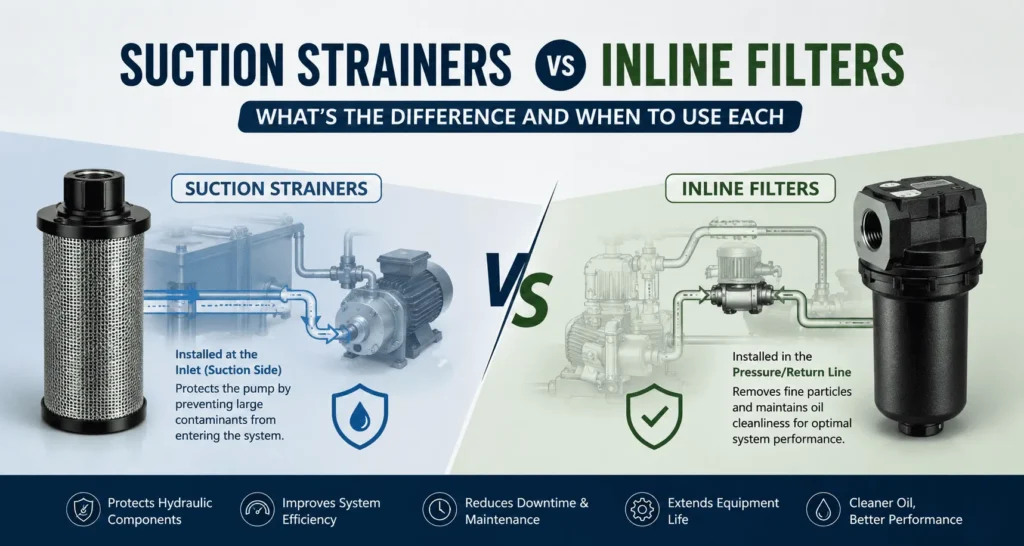
A suction strainer sits on the pump’s inlet line, between the reservoir and the pump itself. Its job is simple: stop large debris — metal shavings, weld slag, dirt introduced during assembly, or particles shaken loose from tank walls — before it reaches the pump and causes catastrophic internal damage.
Suction strainers are deliberately coarse. Most carry a suction strainer micron rating between 75 and 250 microns, which sounds fine until you realise that particles below roughly 40 microns aren’t even visible to the naked eye. In practical terms, a suction strainer is built to catch the equivalent of gravel, not dust — and that coarseness isn’t a design shortcut, it’s a necessity.
A pump doesn’t actually “suck” fluid; it creates a pressure differential at its inlet, and atmospheric pressure pushes fluid in to fill that space. Because this happens at very low pressure — typically well under 15 psi at sea level — there’s very little margin for restriction. Fit a fine-micron element on the suction side and you create enough pressure drop to starve the pump, pulling dissolved air out of solution and causing cavitation: the formation and violent collapse of vapour bubbles inside the pump. Cavitation sounds like the pump is pumping gravel, and it destroys internal components in a remarkably short time.
Most suction strainers include a bypass relief valve as a safety feature. If the strainer clogs, the bypass opens so fluid can keep reaching the pump — a starved pump is a bigger risk to the system than a few contaminants slipping past a blocked strainer.
What Is an Inline Filter?
An inline hydraulic filter — sometimes called a pressure-line filter or a return-line filter depending on where it sits — is installed after the pump, either on the pressure side feeding valves and actuators, or on the return side where fluid comes back to the tank. Unlike a suction strainer, an inline filter operates where there’s enough pressure available to push fluid through a genuinely fine filtration medium without starving anything downstream.
This is where the real cleanliness work happens. Pressure-line filters commonly use media rated between 3 and 10 microns — fine enough to catch the microscopic particulate contamination that causes long-term wear on servo valves, proportional valves, and other precision components. Return-line filters typically use a slightly coarser range but still far finer than any suction strainer, and they play an important role in overall system cleanliness by catching contamination generated inside the system itself — wear particles from seals, cylinders, and valves — before that fluid recirculates back through the pump.
Inline filters are also generally easier to service than strainers. Many use spin-on cartridges or tank-mounted housings with shutoff valves, so elements can be changed without draining the entire reservoir — a meaningful advantage over strainers, which are often mounted inside the tank and harder to reach.
Suction Strainers vs Inline Filters: Side-by-Side Comparison
The table below breaks down where each hydraulic filter type belongs and what happens if you use it incorrectly. Use it as a quick reference when specifying a new system or troubleshooting recurring pump issues.
| Factor | Suction Strainer | Inline Filter (Pressure/Return) |
|---|---|---|
| Location in circuit | Pump inlet, before the pump | After the pump — pressure or return line |
| Typical micron rating | 75–250 microns (coarse) | 3–25 microns (fine) |
| Primary purpose | Stop large debris from damaging the pump | Remove fine contamination protecting downstream components |
| Risk if too fine | Pressure drop leads to pump cavitation | Not applicable — designed for fine filtration |
| Risk if skipped entirely | Pump exposed to large, damaging particles | Valves and actuators wear prematurely from fine contamination |
| Maintenance access | Often tank-mounted, harder to service | Usually spin-on or housed, easier to service |
| Sizing rule | Must be oversized relative to pump flow to limit pressure drop | Sized to system flow rate and pressure rating |
| Best suited for | First line of defence, coarse debris only | Primary cleanliness control for sensitive components |
Why You Can’t Use One in Place of the Other
The single biggest misunderstanding we encounter is the assumption that “a filter is a filter” — that fitting a finer-rated element anywhere in the system automatically means better protection. In a hydraulic circuit, filtration effectiveness depends entirely on location and pressure conditions, not just micron rating.
- Creates excess pressure drop at the pump inlet
- Starves the pump of fluid under normal flow
- Pulls dissolved air out of solution — triggers cavitation
- Cavitation erodes internal pump components rapidly
- Fine particulate contamination passes freely downstream
- Servo and proportional valves wear prematurely
- Precision component clearances degrade silently
- Failures appear months later with no obvious cause
Put a fine-rated element on the suction side, and you’re not upgrading protection — you’re restricting the one place in the circuit that has the least tolerance for restriction. The result, cavitation, is far more destructive to a pump than the contamination the fine filter was meant to stop in the first place. Conversely, relying only on a coarse suction strainer and skipping inline filtration entirely leaves your system’s most sensitive, most expensive components exposed to fine particulate contamination a strainer was never designed to catch.
This matters more than it might seem. Industry data consistently shows that the large majority of hydraulic component failures trace back to contamination and surface degradation, not mechanical wear from normal operation. Getting filtration placement right isn’t a minor spec detail — it’s one of the most cost-effective decisions in a hydraulic system’s design.
How to Choose the Right Filtration Setup for Your System
Rather than treating this as an either/or decision, work through a few practical questions before specifying your system’s filtration.
What’s downstream of this filter?
If you’re protecting a rugged gear pump feeding basic cylinders, your tolerance for contamination is higher than a system running servo valves or proportional controls, where even microscopic particles can cause erratic operation or premature failure. Higher-precision components justify finer inline filtration.
What’s your flow rate, and can the system tolerate pressure drop at the pump inlet?
This determines how oversized your suction strainer needs to be. As a rule, strainers should be significantly oversized relative to the pump’s rated flow to keep pressure drop within safe limits, especially at cold start-up when fluid viscosity is at its highest.
Is this a new system design or a retrofit?
New designs give you the flexibility to place filtration exactly where it belongs. Retrofits sometimes mean working around existing plumbing — this is where consulting with someone who understands filtration placement, rather than just matching micron ratings, makes a real difference.
In most well-designed hydraulic systems, the answer isn’t “strainer or filter” — it’s both, each doing the job it’s suited for. A suction strainer handles first-line coarse protection at the pump inlet, while inline pressure and/or return filtration handles the fine cleanliness control that protects your most sensitive components over the long run.
Common Mistakes We See in the Field
After years of manufacturing and supplying hydraulic filtration components across a wide range of industrial applications, a handful of mistakes come up repeatedly.
- Oversized or undersized strainers causing cavitation. A strainer sized too small for the pump’s actual flow rate creates the same pressure-drop problem as a too-fine element, even at a coarse micron rating.
- Treating the suction strainer as the system’s only filtration. This leaves fine contamination completely unaddressed, and by the time symptoms show up — usually valve sticking or premature actuator wear — the damage is already underway.
- Skipping scheduled strainer cleaning because “it’s just a strainer.” A clogged strainer, even a coarse one, still restricts flow and pushes the system toward cavitation. Strainers need a maintenance schedule just like any other filtration component.
- Assuming micron rating alone determines suitability. Where a filter sits in the circuit matters as much as how fine it filters. A correctly rated element in the wrong location can do more harm than good.
Why Plants Choose Anand Filters for Suction Strainers & Inline Filters
Anand Filters has manufactured and supplied hydraulic filters across Gujarat and pan-India since 2002, offering both coarse suction strainers and fine inline pressure/return elements from a single certified source. Our team helps plants get filtration placement right the first time — reducing pump failures and unplanned downtime.
- Suction strainers and inline filters compatible with HYDAC, Parker, Internormen, and Rexroth housings
- Reusable and cartridge-style elements available depending on application
- Engineering support to help you specify the right filter for your system, not just match a part number
- ISO 9001:2015 certified manufacturing from GIDC Vatwa, Ahmedabad
Get the Right Filtration Configuration — Not Just a Part Number
Our engineering team can review your hydraulic circuit and recommend the correct suction strainer and inline filter combination for your pump, flow rate, and downstream components.
Frequently Asked Questions
Conclusion
Choosing between a suction strainer and an inline filter isn’t really a choice at all in most well-designed hydraulic systems — it’s a question of using each one where it belongs. A suction strainer protects the pump from coarse debris at the one point in the circuit that can least tolerate restriction. An inline filter delivers the fine cleanliness control that protects your most sensitive, most expensive components downstream. Understanding this distinction, and specifying accordingly, is one of the simplest ways to extend hydraulic system life and avoid costly, unplanned downtime.
For help specifying the right combination of filters and strainers for your hydraulic system, contact Anand Filters — ISO 9001:2015 certified manufacturer, 22+ years at GIDC Vatwa, Ahmedabad.