

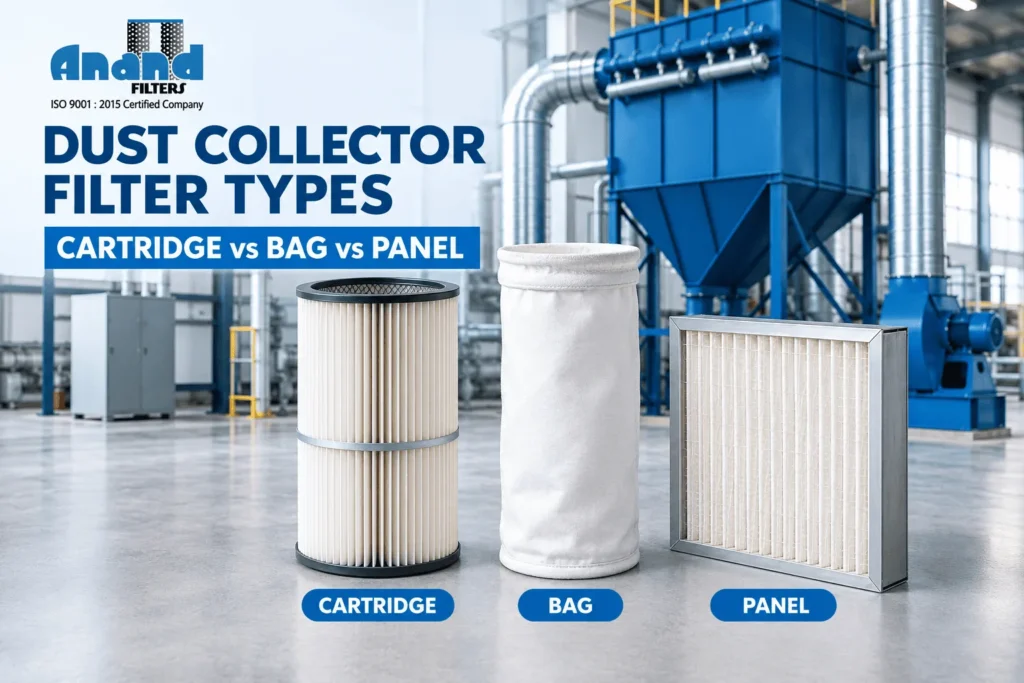
Dust Collector Filter Types Compared: Cartridge vs Bag vs Panel
Every dust collection system relies on one of three basic dust collector filter types — cartridge, bag, or panel — and each one does the same fundamental job (capturing airborne particulate before exhaust air leaves the plant) in a genuinely different way. The three aren’t interchangeable substitutes for each other; they’re built around different trade-offs in filtration area, footprint, dust handling capacity, and maintenance approach.
Getting this choice wrong is more common than it should be, usually because a system gets specified based on what’s familiar or cheapest per unit rather than what actually matches the dust load and space available. This guide compares all three types of dust collector filter side by side — how each works, where each genuinely excels, and how to figure out which one fits your application before you order.
The Three Main Types of Dust Collector Filters — Quick Overview
Before the deep dive into each type, here’s the short version. Cartridge dust collector filters pack a large amount of pleated media into a compact cylindrical shape, making them the space-efficient choice for fine, dry dust. Bag filters use long fabric sleeves and handle higher-volume, coarser, more abrasive dust loads at a lower cost per unit of filtration area, but need more physical space. Panel filters are flat or mini-pleated media in a rigid frame, typically suited to lighter particulate loads or pre-filtration roles rather than heavy-duty primary dust collection. The rest of this guide breaks down exactly when each of these makes sense.
Cartridge Filters — How They Work and Where They Excel
- Deep pleated media in a cylindrical cartridge
- Large surface area in a small footprint
- Cleaned via pulse-jet reverse air
- Best for fine, dry dust
A cartridge dust collector filter works by packing deeply pleated media — often several times the surface area of an equivalent-sized bag — into a compact cylindrical shape. This pleating is what makes cartridge filters the space-efficient option: for a given filtration area, a cartridge system takes up considerably less floor and housing space than an equivalent bag system, which matters in plants where floor space is at a premium.
Cartridge filters are typically cleaned with a pulse-jet reverse air burst that dislodges the collected dust cake back into a hopper below. This works well for fine, dry, free-flowing dust — flour, cement fines, pharmaceutical powders, metal grinding dust — but struggles with sticky, moist, or fibrous material that doesn’t release cleanly from pleated media. Our pleated dust collection cartridges and pleated cartridge elements are built specifically around this fine, dry dust use case.
Bag Filters — How They Work and Where They Excel
- Long fabric sleeves, woven or non-woven
- Lower cost per unit of filtration area
- Handles higher-volume, coarser dust
- Best for abrasive, high-load applications
A bag filter dust collector uses long fabric sleeves — typically woven or non-woven polyester, though aramid and PTFE-laminated options exist for demanding applications — hung inside a housing, with dust-laden air passing through the fabric from outside to inside (or vice versa, depending on system design). The tradeoff versus cartridge filters is straightforward: bags need more physical space for an equivalent filtration area, but they’re generally more tolerant of abrasive, high-volume dust loads and are cheaper on a cost-per-unit-area basis, which is why cement plants, foundries, and mineral processing operations lean heavily toward bag systems.
We’ve covered the material side of this in detail separately — the distinction between woven and non-woven construction affects both efficiency and how the bag behaves under cleaning, covered in our woven vs non-woven filter bags guide. Our non-woven filter bag range covers the material options most commonly specified for industrial bag-house systems.
Panel Filters — How They Work and Where They Excel
- Flat or mini-pleated media in a rigid frame
- Compact, low-profile installation
- Lower dust-holding capacity than cartridge/bag
- Best for lighter loads or pre-filtration
A panel dust collector filter uses flat or shallow-pleated media set into a rigid frame — flange-type or box-type construction being the two most common — and is typically deployed where the dust load is lighter, the airflow is HVAC-adjacent rather than heavy industrial exhaust, or where the panel is serving as a pre-filter ahead of a finer stage (such as a HEPA filter). Panel filters generally have lower dust-holding capacity than cartridge or bag systems, which makes them a poor fit as the sole filtration stage in a high-volume industrial dust application, but they’re well suited to compact installations and general ventilation contexts.
Our flange-type panel filters and box-type panel filters cover the two most common panel configurations used across HVAC and lighter industrial applications.
Dust Collector Filter Types: Side-by-Side Comparison
| Factor | Cartridge | Bag | Panel |
|---|---|---|---|
| Filtration area (relative) | High per unit footprint | Moderate, needs more space | Lower |
| Footprint | Compact | Larger housing required | Very compact, low-profile |
| Cleaning method | Pulse-jet reverse air | Pulse-jet, shaker, or reverse air | Manual replacement, rarely cleaned in place |
| Relative cost per unit area | Higher | Lower | Lowest, but lower capacity too |
| Best-fit dust type | Fine, dry, free-flowing dust | Coarse, abrasive, high-volume dust | Light particulate, pre-filtration role |
| Typical application | Pharma, flour, fine powder, metalworking | Cement, foundry, mineral processing | HVAC, general ventilation, pre-filter stage |
For a more detailed head-to-head specifically on cartridge versus bag (the two most commonly compared for primary dust collection), our cartridge vs bag filters industrial plant guide goes deeper into the operating cost and maintenance trade-offs between those two specifically.
How to Choose the Right Type for Your Application
| Industry / dust type | Recommended type | Why |
|---|---|---|
| Cement, mineral processing | Bag | Handles abrasive, high-volume dust cost-effectively |
| Pharma, food powder handling | Cartridge | Fine dust efficiency in a compact, cleanroom-adjacent footprint |
| Metalworking, welding fume | Cartridge | Fine particulate, space-constrained shop floors |
| General HVAC, ventilation pre-filtration | Panel | Lighter load, compact installation, pre-filter role |
| Foundry, casting operations | Bag | High-temperature tolerance options, abrasive dust handling |
Beyond the industry-level guidance above, three practical questions narrow the decision further: how much floor space is actually available around the collection point, what’s the typical particle size and abrasiveness of the dust, and what’s the required cleaning frequency your maintenance team can realistically sustain. A system that’s technically more efficient on paper but requires cleaning cycles your team can’t keep up with will underperform a simpler, better-matched system in practice.
Common Mistakes When Choosing Between Types
- Comparing only price per filter unit. Total filtration area, replacement frequency, and cleaning downtime all factor into real cost — a cheaper unit that needs replacing twice as often isn’t actually cheaper.
- Undersizing a cartridge system for high-volume abrasive dust. Cartridge media isn’t built for the same abrasion tolerance as bag fabric, and undersizing accelerates media wear significantly.
- Using panel filters as the sole stage for heavy industrial dust loads. Panel filters have meaningfully lower dust-holding capacity — treating them as a primary collector rather than a pre-filter leads to rapid blinding and frequent replacement.
- Not checking existing housing compatibility. Retrofitting a different filter type into an existing housing without confirming dimensional and airflow compatibility is a common and avoidable installation headache.
For a broader look at specifying a dust collection system from scratch — not just the filter element itself — our buying guide for industrial dust collectors in India is a useful companion read, and if you’re at the point of evaluating suppliers rather than just filter types, our filter bag manufacturer buyer’s checklist covers what to verify before committing to a supplier.
For general background on how particulate filtration works as a broader engineering category, Wikipedia’s overview of air filters is a useful general reference.
Why Plants Choose Anand Filters Across All Three Dust Collector Filter Types
Anand Filters manufactures cartridge, bag, and panel dust collector filters in-house from GIDC Vatwa, Ahmedabad, which means we’re not steering you toward one type because it’s the only one we make. Our engineering team helps match filter type to your actual dust load, space constraints, and maintenance capacity rather than defaulting to the most familiar option.
- Full range across cartridge and panel dust collection categories
- Woven, non-woven, and PTFE-laminated bag options for high-volume abrasive applications
- Engineering support to size and specify based on your dust type, not just catalogue matching
- ISO 9001:2015 certified manufacturing with 22+ years of industry experience
Not Sure Which Filter Type Fits Your Dust Collection System?
Share your dust type, volume, and available space — our engineering team will recommend the right filter type and specification before you order.
Frequently Asked Questions
Conclusion
There’s no universally “best” option among the three dust collector filter types — cartridge, bag, and panel each solve a different combination of dust load, footprint, and cost constraints. Cartridge filters win on compact fine-dust efficiency, bag filters win on cost-effective handling of abrasive high-volume dust, and panel filters win on compact pre-filtration and light-load applications. Matching the type to your actual dust and space constraints, rather than defaulting to whichever is most familiar, is what separates a dust collection system that runs reliably from one that needs constant attention.
For help specifying the right dust collector filter type for your plant, contact Anand Filters — ISO 9001:2015 certified manufacturer, 22+ years at GIDC Vatwa, Ahmedabad.