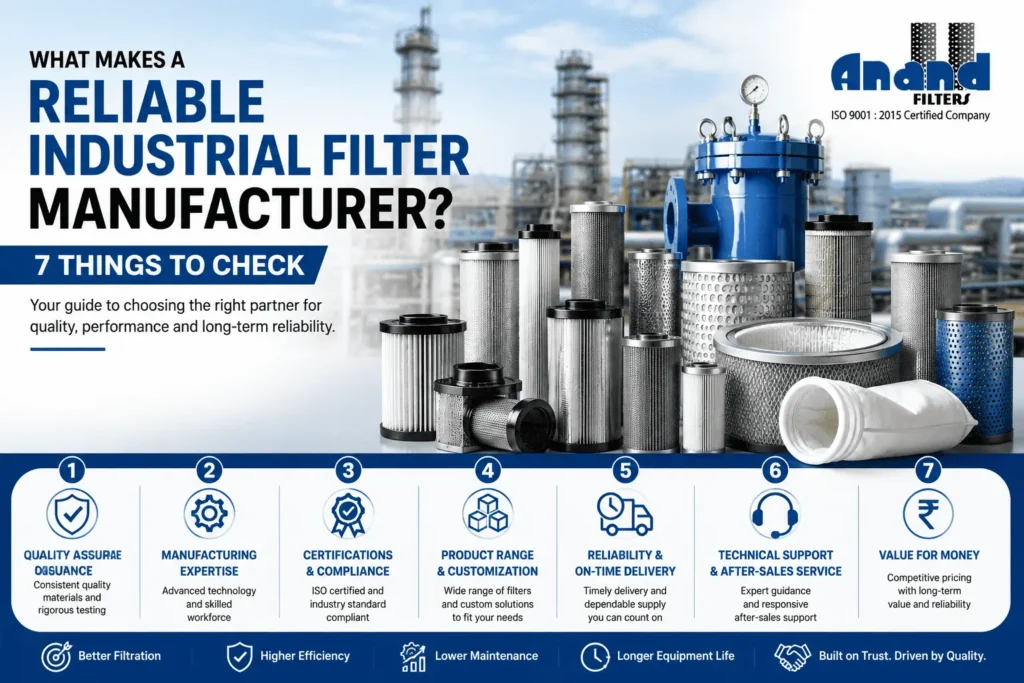
What Makes a Reliable Industrial Filter Manufacturer? 7 Things to Check
Search for an industrial air filter supplier in India and you’ll find dozens of businesses calling themselves a filter company — some genuine manufacturers, others traders repackaging someone else’s product, and a few that exist mainly as a listing on a directory site. For a plant engineer or procurement manager, telling these apart from a website alone is genuinely difficult, because most sites use nearly identical language: “leading manufacturer,” “quality assured,” “trusted supplier.”
The distinction matters more than it might seem. An unreliable filter supplier doesn’t just risk a late delivery — it risks inconsistent micron ratings between batches, contamination reaching sensitive equipment, and compliance failures in regulated industries like pharma or food processing. This guide walks through seven concrete things you can check before trusting an industrial filter manufacturer with your plant’s filtration needs, along with how to actually verify each one rather than taking a claim at face value.
Why the Manufacturer You Choose Matters as Much as the Filter Itself
It’s tempting to treat filter sourcing as a straightforward spec match — same micron rating, same dimensions, lowest price wins. In practice, two filters that look identical on paper can perform very differently depending on who made them and how consistently they control quality across production batches. A reliable filter manufacturer isn’t just selling you a component; they’re taking on responsibility for consistency across every reorder, technical support when something doesn’t perform as expected, and accountability if a batch falls outside specification.
This is especially true in industries with tight tolerances or regulatory requirements — pharmaceutical cleanrooms, food and beverage processing, and refineries all depend on filtration performance that doesn’t drift between orders. Choosing a manufacturer without genuine manufacturing capability, quality documentation, or industry experience introduces risk that often doesn’t show up until months later, when a contamination issue or unexpected downtime forces a root-cause investigation back to the filter itself.
The 7 Things to Check Before You Trust an Industrial Filter Manufacturer
1ISO Certification and Documented Quality Systems
This is the single fastest filter to apply when narrowing down a shortlist. An ISO 9001-certified filter company has an externally audited quality management system covering everything from raw material inspection to final product testing. Certification alone doesn’t guarantee perfect quality, but its absence is a meaningful gap — it means there’s no independent verification that the manufacturer’s internal processes are consistent or documented at all. Ask for the actual certificate, check the certifying body, and confirm it hasn’t lapsed.
2In-House Manufacturing vs Trading
Many businesses calling themselves a filter manufacturer are actually reselling product made by someone else. This isn’t inherently dishonest, but it changes what you should expect — limited customization, less direct accountability if a batch has issues, and technical questions that get relayed back to a third party rather than answered directly. Ask specifically whether the filters are produced in-house or sourced externally, and if possible, ask to see or virtually tour the manufacturing facility. We covered this distinction in more depth, including a direct comparison table, in our filter bag manufacturer buyer’s checklist, and the same logic applies across every filter category, not just dust collection.
3Industry-Specific Experience Across Applications
Filtration requirements vary enormously by industry. A manufacturer with genuine depth will have specific experience — not just a generic product catalogue — across sectors like pharmaceutical and biotech cleanrooms, refineries, and steel manufacturing. Ask what percentage of their business comes from your specific industry, and request examples of similar applications they’ve supplied for. A manufacturer who can speak specifically about your industry’s contamination challenges is a very different proposition from one offering the same generic pitch regardless of application.
4OEM Equivalency and Cross-Reference Capability
For plants running equipment from major OEMs, a manufacturer’s ability to supply verified equivalent replacement filters — matched precisely to original specifications rather than approximated — is a strong indicator of engineering depth. This capability is visible in how a manufacturer documents cross-reference part numbers for brands like HYDAC and Parker hydraulic systems. A manufacturer that can only say “it should work” rather than pointing to a documented cross-reference hasn’t done the engineering work to back that claim.
5Material Traceability and Testing Standards
Ask how the manufacturer tracks material batches and what testing is performed before a filter ships — efficiency testing, dimensional checks, and pressure/flow validation should all be standard practice, not an optional add-on. A manufacturer that can trace a specific filter back to its raw material batch and test records is one that can actually investigate and resolve a quality issue if one arises, rather than simply offering a replacement and hoping it doesn’t recur.
6Customization and Engineering Support
Standard catalogue sizes work for straightforward applications, but retrofits, older equipment, and non-standard housings often need custom dimensions, materials, or configurations. A capable manufacturer should have engineering support that can work through your specific requirement, not just point you toward the closest standard product. This is often where the real difference between a filter company that manufactures and one that only distributes becomes obvious.
7Track Record, Client Base, and After-Sales Support
Years in operation, the range of industries served, and what happens after the sale all matter. Ask for references or case studies from similar plants, and clarify what after-sales support actually looks like — is there a technical contact you can reach when troubleshooting a filtration issue, or does support end at the invoice? A manufacturer confident in their product quality is usually willing to share both.
Reliable Manufacturer vs Red Flag: Quick Reference
| What you’re checking | Sign of a reliable manufacturer | Red flag |
|---|---|---|
| Certification | Produces a valid, current ISO certificate on request | Says “certified” with no documentation offered |
| Manufacturing | Owns and operates the production facility | Vague or evasive about where products are made |
| Industry experience | Specific examples matched to your sector | Generic pitch regardless of your industry |
| OEM equivalency | Documented cross-reference part numbers | “It should fit” with no supporting data |
| Traceability | Can trace a batch to raw material and test records | No batch tracking system in place |
| Customization | In-house engineering can adapt to your spec | Standard catalogue only, no flexibility |
| After-sales support | Named technical contact post-purchase | Support ends once the invoice is paid |
How to Actually Verify These Claims During Your Evaluation
Reading a manufacturer’s “About” page tells you what they want you to believe. Verification means actively testing those claims. Request the ISO certificate number and check it against the certifying body’s public register rather than trusting a logo on a website. Ask for a small trial order or sample before committing to a full production run — a manufacturer confident in consistency will accommodate this without resistance. Request two or three references from plants in your industry, and actually call them. And ask direct, specific questions during any sales conversation: what’s your typical lead time for a reorder, how do you handle a batch that fails inspection, and can I speak with your technical team, not just sales.
It’s also worth looking at how a manufacturer’s product range maps to your actual needs. A manufacturer serving many industries across the industries typically served by Indian filter manufacturers tends to have broader engineering exposure than one focused narrowly on a single product line. If you’re comparing options by location, a buyer’s guide to manufacturers in Ahmedabad can help frame what to expect from that specific industrial cluster.
Common Mistakes When Evaluating Filter Companies
- Treating “manufacturer” as a self-verifying label. The word appears on almost every filtration website regardless of whether the company actually produces anything in-house.
- Comparing only on listed price. A lower price from an unverified source often reflects lower quality control, not genuine efficiency — the real cost shows up later in downtime or replacement frequency.
- Skipping the sample/trial order step. Committing to a full order before verifying quality on a small batch removes your best low-risk verification opportunity.
- Not distinguishing standard vs custom capability early. If your application needs anything non-standard, confirm engineering flexibility before you’re locked into a supplier relationship. See the trade-offs in more detail in our custom vs standard filters manufacturer’s guide.
For readers who want a more formal grounding in what an ISO 9001 certification actually verifies — the specific quality management requirements a manufacturer must meet to earn and retain it — Wikipedia’s overview of the ISO 9000 family of standards is a useful general reference.
How Anand Filters Measures Up Against This Checklist
Anand Filters has operated as an ISO 9001:2015 certified, in-house manufacturer from GIDC Vatwa, Ahmedabad since 2002 — not a trading business reselling third-party product. Our track record was documented in more depth in this overview of why plants trust us as a filter supplier, and we’ve also written specifically about the factors industrial air filter manufacturers must actually consider to serve demanding applications well.
- ISO 9001:2015 certified with documented, auditable quality systems
- In-house manufacturing across hydraulic, compressor, dust collector, panel, and HEPA filter categories
- Documented OEM cross-reference capability for major hydraulic and compressor brands
- Engineering support for custom sizes and non-standard applications
- 22+ years serving pharma, refineries, steel, cement, and general manufacturing plants across India
Evaluating Filter Companies? Put Us Through the Same Checklist
Ask us for our ISO certificate, request a sample batch, or talk to our engineering team directly — we’re happy to be verified against every point in this guide.
Frequently Asked Questions
Conclusion
Choosing a reliable industrial filter manufacturer comes down to verifying substance behind the marketing language every filter company uses. Certification, in-house manufacturing, industry-specific experience, OEM equivalency, traceability, customization capability, and genuine after-sales support are the seven factors worth checking before you commit — and each one is verifiable with a direct question or a document request, not just a claim on a website.
If you’re evaluating industrial air filter suppliers for your plant, contact Anand Filters and put us through this same checklist — ISO 9001:2015 certified manufacturer, 22+ years at GIDC Vatwa, Ahmedabad.