

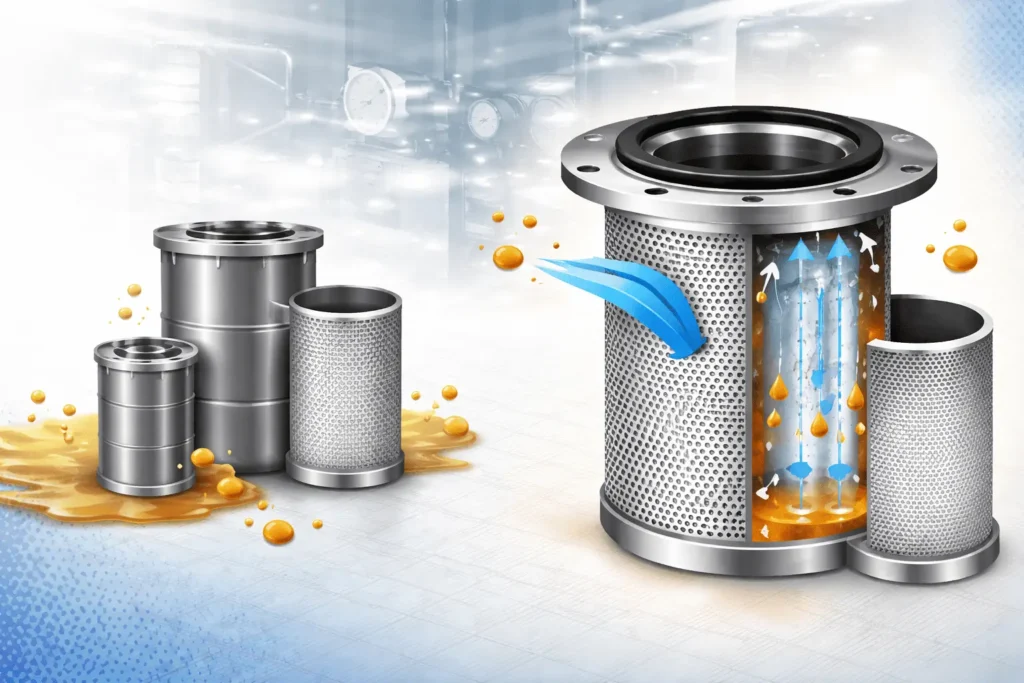
Oil Separator Symptoms: 7 Warning Signs Your Compressor Separator Is Failing
A failing oil separator rarely announces itself all at once. It degrades quietly – until oil contaminates your downstream equipment, your compressor overheats, or your production line stops unexpectedly. Recognising oil separator symptoms early is the single most cost-effective maintenance decision you can make, whether you operate a rotary screw compressor in an industrial plant or you are troubleshooting bad oil separator symptoms on a VW or Audi engine. Here are the seven warning signs to act on immediately.
What Does an Oil Separator Do?
An oil separator removes oil aerosols from compressed air in a screw compressor, or removes oil vapour from crankcase blow-by gases in an automotive engine. In industrial systems, it sits between the compression chamber and the air outlet. In engines — particularly VW and Audi — it forms part of the crankcase ventilation system.
When it works correctly, you get clean compressed air and a controlled engine environment. When it fails, the consequences range from contaminated air lines to engine oil separator failure that damages downstream components and triggers expensive repairs.
7 Warning Signs Your Oil Separator Is Failing
Sign 1: Oil Carryover in Compressed Air
The clearest sign of separator failure is oil mist or liquid oil appearing downstream of the separator — on air tools, pneumatic valves, dryers, or air lines. A healthy separator limits oil carryover to 2–5 ppm. A saturated or ruptured element can push that above 20–50 ppm.
Visually inspect filters and downstream equipment for oily residue. If contamination is not immediately visible, test with compressed air oil content strips or an inline oil sensor. Do not wait for equipment damage to confirm the problem.
Sign 2: Unexplained Oil Consumption
If you are topping up compressor oil more frequently than your service schedule requires — without any visible oil separator leaking externally — the separator element is the first component to investigate. Oil is being carried over into the air stream and lost, rather than returning to the sump.
Track oil consumption per 1,000 running hours. Consumption above 5 mg/m³ on a well-maintained screw compressor points to separator degradation. In automotive engines, unexplained oil loss without any drips beneath the vehicle is a recognised engine oil separator failure sign that warrants immediate inspection.
Sign 3: Blue or Grey Discharge Smoke
Blue or grey smoke from a compressor air outlet — or from a vehicle exhaust — is a textbook oil separator symptom caused by oil vapour entering the air or combustion gas stream.
In screw compressors, this appears as visible mist at the discharge point. In petrol and diesel engines — particularly Audi and Volkswagen applications — blue exhaust smoke on cold start is one of the most recognised Audi oil separator symptoms. Oil vapour is drawn back through the intake manifold, enters the combustion chamber, and burns alongside the fuel charge.
Sign 4: External Oil Separator Leaking
Visible oil around the separator housing, seals, or connection ports is an oil separator leak sign that should never be dismissed as minor seepage. External leaks indicate a degraded housing seal, a cracked separator body, or loose connections caused by pressure cycling over time.
In automotive systems, look for oil residue around the separator cap or crankcase ventilation hose fittings. In industrial compressors, inspect the separator bowl and element retaining ring. Even a small external leak accelerates internal element failure and creates a genuine slip and fire hazard in the plant environment.
Sign 5: Rising Differential Pressure Across the Separator
Most industrial screw compressors include a differential pressure (ΔP) gauge across the oil separator element. A clean element reads 0.2–0.5 bar ΔP under normal operating conditions. As the element saturates, ΔP climbs — one of the most reliable early indicators of oil separator in screw compressor problems.
When ΔP exceeds 0.8–1.0 bar, the element is at or beyond its service life. Many compressors will trigger an automatic high-ΔP alarm at this point. Do not bypass or ignore that alarm. A fully saturated element under high differential pressure can rupture, sending unfiltered, oil-laden air directly into the distribution system.
Sign 6: Compressor Running Hotter Than Normal
A degraded or blocked separator restricts airflow through the separator stage, forcing the compressor to work harder and run hotter than it should. If your discharge temperature is trending upward without any change in ambient conditions or production load, check the separator element before assuming a cooling system fault.
Elevated running temperature accelerates oil oxidation, shortens bearing life, and — in the worst case — triggers thermal overload protection and an unplanned shutdown. This is one of the most frequently misdiagnosed oil separators in screw compressor problems, often attributed to cooling fan or heat exchanger issues when the separator is the actual cause.
Sign 7: Persistent Oil Smell from Air Outlets or Vehicle Cabin
An oil smell from compressed air outlets, downstream equipment, or — in automotive applications — from inside the vehicle cabin is a sensory warning sign that oil vapour is bypassing a degraded separator.
In VW engines with a failing crankcase ventilation separator, oil vapour recirculates through the intake and enters the cabin via the HVAC system. If you notice a burning oil smell during cold starts or at idle with the climate control running, bad oil separator symptoms in a VW should be high on your diagnostic list.
Oil Separator Symptoms in VW and Audi Engines
VW Group engines — particularly the 2.0 TFSI, 1.4 TSI, and 2.0 TDI variants — have a known tendency for crankcase oil separator degradation as mileage accumulates. The separator is a plastic or composite component that becomes brittle with heat cycling and eventually cracks or deforms.
Audi oil separator symptoms and bad oil separator symptoms in VW vehicles to watch for include:
- Blue exhaust smoke on cold start that clears as the engine warms
- Rough idle caused by unmetered air entering through separator cracks
- Increased oil consumption without visible external leaks
- Engine management warning light (often a lean mixture or boost pressure fault)
- Oil residue or oil smell around intake hose connections
Replacement is typically straightforward on most engine variants and resolves all of the above symptoms when completed promptly with a quality separator element.