

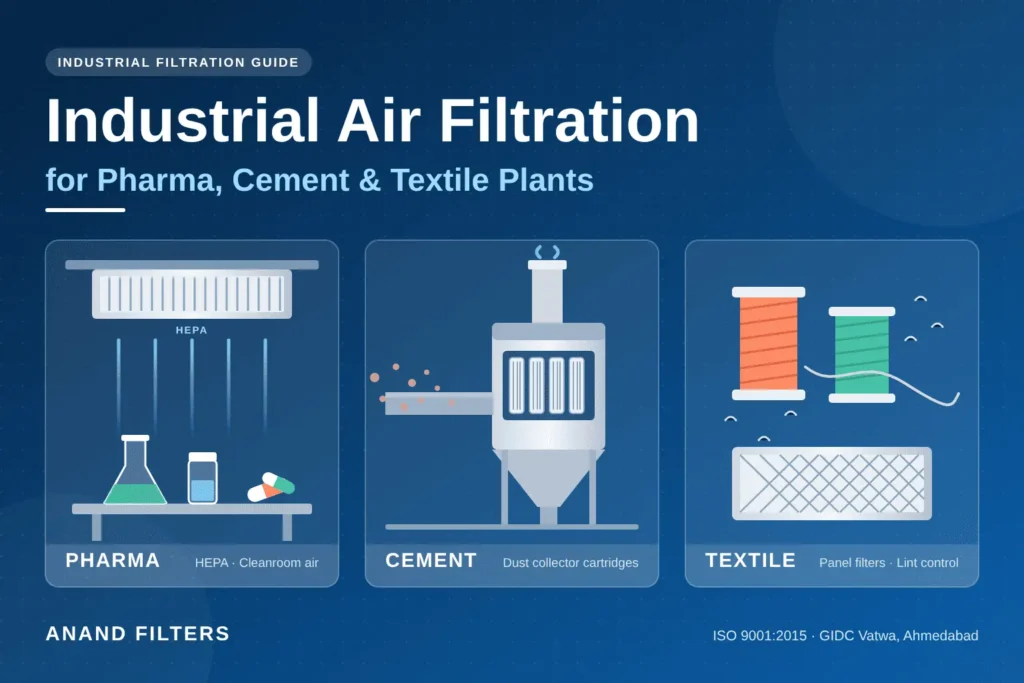
Industrial Air Filtration for Pharma, Cement and Textile Plants
Clean air means something different in every plant. In a tablet-coating suite it protects the product and the patient. In a cement plant it keeps kiln, mill and packing dust inside the system instead of inside the neighbourhood. In a spinning hall it keeps lint off the machines and out of workers’ lungs. Understanding industrial air filtration applications industry by industry is therefore the first step before you discuss specifications with any of the air filter manufacturers on your shortlist.
This guide looks at three demanding sectors: pharmaceutical, cement and textile plants. For each one, we explain what contaminants you are fighting, which filters do the job, which standards apply and how to keep the system working. We also show why industry specific filters usually outperform a one-size-fits-all approach to dust control.
Table of Contents
- Industrial Air Filtration Applications at a Glance
- Pharma Plants: Cleanrooms, OSD and Aseptic Areas
- Cement Plants: Heavy-Duty Dust Control
- Textile Plants: Lint, Fibre and Humidity
- Other Industries That Rely on Air Filtration
- How to Choose Industry Specific Filters
- Common Mistakes Across All Three Industries
- Maintenance Checklist by Industry
- Frequently Asked Questions
- Conclusion
Industrial Air Filtration Applications at a Glance
Every plant needs filtration, but the reason, the contaminant and the filter stack change completely from one sector to another. The table below compares the three industries covered in this guide before we go into detail.
| Industry | Main contaminant | Main goal | Typical filter stages | Standard or norm | Risk if filtration fails |
|---|---|---|---|---|---|
| Pharma | Fine particles, microbe carriers, active ingredient dust | Product protection, GMP compliance, operator safety | Prefilter, fine filter, terminal HEPA; cartridge dust extraction in solid-dose areas | ISO 14644-1, EN 1822 / ISO 29463, applicable GMP guidelines | Contamination, rejected batches, audit observations |
| Cement | Raw meal, clinker and cement dust, hot process gas | Emission control and product recovery | Pulse-jet baghouse with temperature-rated bags | State and central pollution control board norms | Visible emissions, penalties, bag burn-through, fan wear |
| Textile | Lint, short fibre, cotton dust | Product quality, worker health, fire prevention | Coarse lint screen, panel or fine filters, bag or cartridge dust collector | Factory and occupational safety requirements | Yarn and fabric defects, fouled machines, fire |
If you want the wider picture of why filtration matters across manufacturing, read why industrial filtration systems are important for manufacturing. To see how plant filtration differs from building ventilation, see industrial air filtration vs indoor air quality HVAC filters.
Pharma Plants: Cleanrooms, OSD and Aseptic Areas
In pharmaceutical manufacturing, air is a raw material. It touches the product, the operator and the equipment, and regulators inspect it as closely as they inspect the formulation. That is why pharma is one of the most exacting industrial air filtration applications, and why filters for pharma and biotech are specified differently from those used in heavy industry.
Why pharma filtration is about protection, not only dust removal
A pharma plant filters air for two opposite reasons. Supply air must be clean so that particles and microbe-carrying dust do not reach the product. Exhaust and extraction air must be cleaned so that potent powders do not leave the room or reach operators. Both jobs rely on staged filtration, and both are documented as part of the facility’s contamination control strategy.
The filter train: prefilter, fine filter and terminal HEPA
Pharma air handling works as a sequence, with each stage protecting the next:
- Coarse prefilters: stop large dust and insects at the air handling unit intake, commonly in the G4 class.
- Fine filters: remove finer particles before the air reaches the final stage, commonly in the F7 to F9 range.
- Terminal HEPA filters: installed at the point of supply into the room, these are the final barrier for critical areas.
Skipping or under-specifying the early stages is the most common reason terminal HEPA filters clog and need early replacement. Our range of panel filters covers the prefilter and fine-filter stages, including box type filters and flange type filters for different housing designs.
Which HEPA grade for which area
HEPA and ULPA filters are graded under EN 1822 and ISO 29463 by how efficiently they capture the most penetrating particle size. The table below shows the usual mapping, but always confirm the final choice against your own contamination control strategy and your cleanroom qualification.
| Filter class | Efficiency at most penetrating particle size | Typical use |
|---|---|---|
| H13 | At least 99.95% | Supply air for lower-grade areas (GMP Grade C and D) where risk assessment supports it |
| H14 | At least 99.995% | Critical areas (Grade A and B), sterile filling zones and many high-risk rooms |
| ULPA (U15 and above) | At least 99.9995% | Specialised isolators and very critical processes where extra retention is justified |
Grade A and B areas correspond to ISO Class 5 conditions under ISO 14644-1, which is why HEPA filtration is mandatory there. For a deeper look at media, standards and testing, read our guides on HEPA filters for high-efficiency clean air and HEPA filter standards and industry applications. You can also browse our HEPA filter range.
Dust extraction in oral solid dosage areas
Milling, blending, granulation, compression and coating all release fine powder. Capturing it at the source protects operators and prevents cross-contamination between products. Pleated cartridge collectors are widely used here because they give a large filtering area in a compact housing. See our pleated dust collection cartridges for a compact, high-area option.
Exhaust, containment and compressed air
When a room handles potent or hazardous compounds, the exhaust path needs its own HEPA stage, and filter changes must be planned so that nobody is exposed to the used element. Plants that use compressed air for packaging or process equipment also need clean air at the point of use, which starts with the right compressor protection. Our guide to the types of compressor filters explains the filters involved. For wider trends, read advanced air and gas filtration trends in food, pharma and biotech.
Testing and replacement basics
Terminal HEPA filters are normally integrity-tested after installation and at defined intervals, using an aerosol challenge to detect leaks. Rising pressure drop across the filter bank, a failed integrity test or a change in room particle counts are the main triggers for replacement. Keep records for every change, because documentation is part of the compliance story.
Cement Plants: Heavy-Duty Dust Control
Cement making is dust-intensive from the first blast in the quarry to the last bag on the truck. Effective dust control here is both an environmental requirement and a commercial one, because every kilogram of captured dust is product you do not lose. Our overview of filters for the cement industry shows the range we supply for these duties.
Where the dust comes from
- Crushing and handling: limestone and clay crushers, belt transfer points and stockpiles.
- Raw mill and kiln feed: fine, abrasive raw meal.
- Kiln and clinker cooler: hot gas carrying fine dust, often with moisture and chemical content.
- Cement mill, silos and packing: very fine product dust that must be recovered and kept out of the work area.
Baghouse and dust collector selection
Most cement plants use pulse-jet baghouses, where a short burst of compressed air cleans the bags in sequence while the system keeps running. Cartridge collectors suit some compact transfer points, while bag collectors dominate high-volume and hot-gas duties. To understand the trade-offs, read dust collector filter types: cartridge vs bag vs panel and our buying guide for industrial dust collectors in India. If you want to know how the bags themselves work, see how dust collector bags work.
Filter media by temperature
Bag media must survive the gas temperature at that point in the process. The figures below are approximate continuous limits, so always confirm exact ratings and chemical compatibility on the media data sheet before ordering.
| Media | Approximate continuous temperature | Best suited to | Watch out for |
|---|---|---|---|
| Polyester (needle felt) | Up to about 130 °C | Crushers, raw material handling, silos, packing, ambient dust | Not suitable for hot kiln or cooler gas |
| Aramid | Up to about 200 °C | Coolers and moderate-temperature process gas | Sensitive to moisture and acid in some conditions |
| PTFE-based media | Up to about 240 °C | Hot, chemically aggressive or sticky dust | Higher cost, so reserve for where it pays back |
| Fibreglass | Up to about 260 °C | Very hot gas | Brittle, so flex abrasion shortens life |
Our non-woven filter bags cover many of the ambient and moderate-temperature points in a cement plant. For newer media options such as nanofibre layers and coatings, read next-gen filter bag materials.
Gas conditions: dew point and bag blinding
Hot gas that cools below its dew point forms moisture inside the baghouse. Wet dust cakes on the bag surface, blinds the media and raises pressure drop until the fan can no longer pull enough air. Keep gas temperatures safely above the dew point, insulate hoppers and ducts, and make sure start-up and shutdown routines avoid condensation. This matters even more in India during the monsoon, when humid ambient air adds to the problem. See industrial filter maintenance during the monsoon for practical steps.
Emission compliance
Cement plants operate under limits set by the central and state pollution control boards. Because these limits and their measurement methods are updated from time to time, check the current norm for your plant and source before you finalise the collector design. A baghouse sized with generous filtering area and fitted with correct media makes meeting those limits much easier.
Bag life and maintenance
Bag life depends on temperature, abrasion, chemical attack and cleaning frequency. Warning signs include rising differential pressure, dust at the stack, damaged bags at the pulse line and frequent cleaning cycles. Follow the guidance in should you clean or replace your dust collector filter and how to maximise dust collector efficiency to get the most from each set of bags.
Textile Plants: Lint, Fibre and Humidity
Textile mills generate a steady stream of light, fluffy particles. Lint and fibre dust settle on machines, cause yarn and fabric defects and create a respiratory risk for workers. Among all industrial air filtration applications, textile is the one where air handling also supports the process itself, because temperature and humidity affect how fibres behave.
Where the lint and dust come from
- Blowroom and carding: the heaviest release of cotton dust, trash and short fibre.
- Spinning and winding: continuous fine lint around frames and winders.
- Weaving and finishing: fibre fly, sizing dust and fabric lint.
- Waste handling: conveying and baling of fibre waste.
Pre-filtration, fine filtration and dust collectors
A well-designed textile system removes lint in stages. A coarse lint screen or pre-filter takes the bulk of the fibre, which protects the finer stages. Panel filters then clean the air that is recirculated through the plant, and a bag or cartridge dust collector handles the extraction points at machines. Panel filters suit the recirculation stage, and the guide to panel filter costs helps you compare grades by lifecycle cost rather than purchase price alone. For extraction points, see our dust collector cartridges and how to select the right non-woven filter bag.
How filtration interacts with humidity control
Spinning and weaving halls are usually humidified, because fibres break less and run better at controlled moisture levels. Humid air changes how filters behave: lint can become damp and sticky, and filters load faster. Choose media that tolerates moisture, avoid placing absorbent media directly downstream of humidification sprays, and watch pressure drop more closely in humid seasons. Our note on the seasonal impact on industrial filtration needs explains how filter loading changes through the year.
Fire and combustible dust awareness
Safety note: accumulated fibre and fine dust can ignite, and some fine organic dusts can burn rapidly in suspended form. Keep ducts, housings and hoppers clean, remove ignition sources and have the system reviewed under your plant’s fire and explosion safety requirements. Filter selection should always be part of that wider risk assessment.
Maintenance in cotton-heavy plants
Lint builds up fast, so inspection frequency matters more than any fixed interval. Check pressure-drop gauges every shift, clear screens and pre-filters regularly, and replace panel filters when the differential pressure reaches the limit set at commissioning. Keep a stock of spare elements so that a loaded filter never has to be left in service.
Other Industries That Rely on Air Filtration
The same logic applies to every sector: identify the contaminant first, then choose the filter. If your plant is not one of the three above, these pages cover our work in other industries:
- Filters for the ceramics industry
- Filters for the mining industry
- Steel industry filters
- Filters for the power plant industry
- Filters for the chemicals industry
- Filters for the petrochemicals industry
- Filters for dairy, food and beverages
For an overview across sectors, read industries served by filter manufacturers in India.
How to Choose Industry Specific Filters
Before you request a quotation, gather the following details. They let a supplier recommend the correct filter first time and avoid costly rework.
| What to define | Why it matters |
|---|---|
| Contaminant type and particle size | Decides filter class, media and whether you need HEPA, bag or panel filtration |
| Temperature and humidity | Sets the media and construction; wrong media fails early |
| Airflow in m³/h or CFM | Determines filter area and pressure drop |
| Required efficiency or standard | Needed for compliance in pharma and for emission limits in cement |
| Pressure drop budget | Affects fan energy cost over the filter’s life |
| Housing size and access | The element must fit your existing frame, door and sealing design |
| Maintenance plan and spares | Prevents unplanned stops and keeps changeovers short |
When a standard size does not fit your housing or your process, a custom build may be the better answer. Read custom filters vs standard filters to see when each option makes sense, and 7 things to check in a reliable industrial filter manufacturer to assess a supplier. For budgeting, see industrial filter price in India.
Common Mistakes Across All Three Industries
- Using one filter grade everywhere. A filter that suits a packing line may fail in a hot kiln duct or a sterile suite.
- Skipping prefilters. Without protection, expensive fine and HEPA filters clog far sooner than they should.
- Ignoring pressure-drop readings. The gauge tells you when a filter is loaded, before output, energy cost or compliance suffers.
- Choosing media on price alone. A cheaper bag that lasts half as long costs more once downtime and labour are counted.
- Replacing only after a failure. Planned changes cost far less than an unplanned stop.
- Treating commercial and industrial filters as equal. Industrial duty needs tougher media, frames and seals. See industrial filters vs commercial filters.
Maintenance Checklist by Industry
Replacement intervals depend on the process, the site and the filter. Use this table to decide what to monitor, and take interval figures from your product data sheet or qualification records.
| Industry | What to monitor | Typical trigger for action |
|---|---|---|
| Pharma | Differential pressure, integrity test results, room particle counts | Pressure limit reached, failed integrity test, out-of-limit counts |
| Cement | Differential pressure, stack emissions, bag condition, gas temperature | Rising pressure drop, visible dust at the stack, damaged bags |
| Textile | Differential pressure each shift, lint build-up on screens, humidity | Pressure limit reached, loaded or damp filters |
Frequently Asked Questions
What are the main industrial air filtration applications?
The main industrial air filtration applications are cleanroom air supply in pharma, dust collection in cement, mining and steel, lint and fibre control in textiles, and fume or particle control in chemical, food and power plants.
What filter is used in a pharmaceutical cleanroom?
Pharmaceutical cleanrooms use HEPA filters, usually H13 or H14 under EN 1822, installed at the room supply and protected by coarse and fine prefilters upstream.
Which filter media is best for cement plant dust collectors?
It depends on gas temperature. Polyester suits ambient dust, aramid suits moderate heat, PTFE-based media suits hot or aggressive dust, and fibreglass suits very hot gas.
How does a textile mill control lint and dust?
A textile mill removes lint in stages: a coarse pre-filter, panel filters for recirculated air and a bag or cartridge dust collector at machine extraction points, with humidity controlled alongside.
What is the difference between a HEPA filter and an industrial dust collector?
A HEPA filter cleans air to very high efficiency for clean spaces. An industrial dust collector captures heavy dust loads at the source and is cleaned repeatedly, usually by pulse-jet or shaking.
How do I choose the right industrial air filter for my plant?
Define the contaminant, temperature, humidity, airflow, required efficiency and housing size first. Then match media and filter class to that duty, and confirm with a supplier’s data sheet.
Conclusion
The best industrial air filtration applications start with the plant, not the filter catalogue. Pharma plants need staged filtration that ends in tested HEPA protection. Cement plants need temperature-rated bags and disciplined dust control to stay within emission limits. Textile plants need lint removal that works alongside humidity control and fire safety. In every case, industry specific filters, correct prefiltration and regular monitoring cut downtime and running cost.
Anand Filters: Industrial Filter Manufacturers supplies panel filters, HEPA filters, dust collector cartridges and filter bags for these and other sectors. Learn more about us, review our certifications or explore our services.
Need filters matched to your plant? Share your industry, airflow, temperature and housing size, and our team will recommend the right elements. Contact Anand Filters for a quotation.