

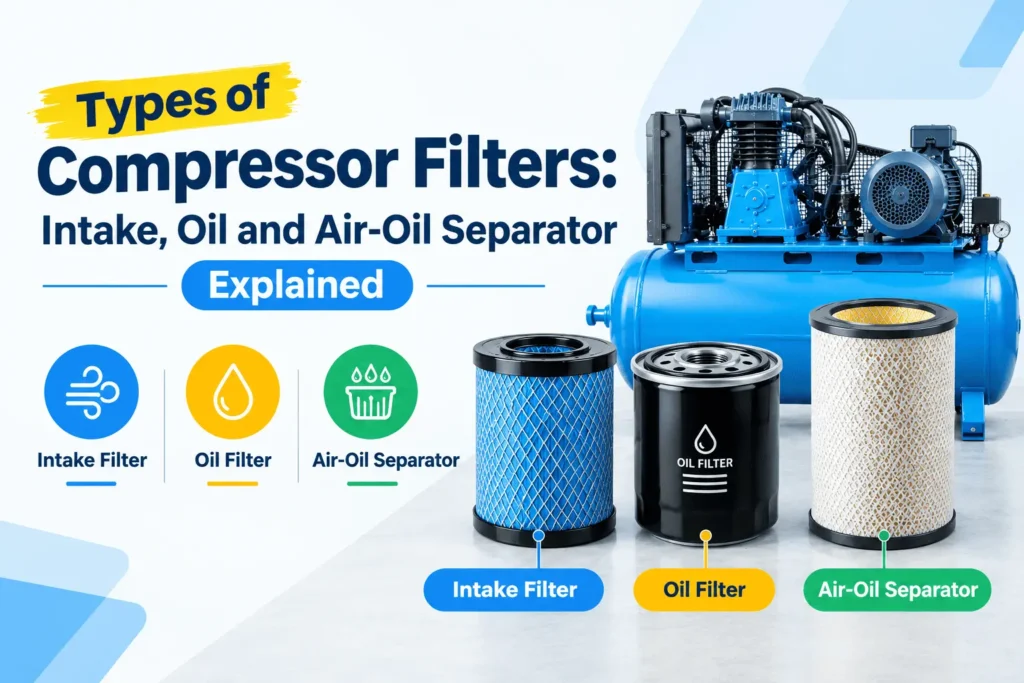
Types of Compressor Filters: Intake, Oil & Air-Oil Separator Explained
Quick navigation
- Why compressor filters matter
- Types of compressor filters at a glance
- Compressor intake filter (air filter)
- Oil filter for compressor
- Air-oil separator filter
- Inline compressed-air filters
- Which filters does your compressor use?
- How to choose the right compressor filter
- Replacement schedule cheat sheet
- Common mistakes that shorten filter life
- FAQs
- Conclusion
Every industrial compressor does three jobs at once: it draws in outside air, circulates lubricating oil, and delivers clean compressed air to your plant. Each of those jobs needs its own protection, which is why there is no single filter that does it all. Knowing the types of compressor filters, what each one removes and where it sits in the machine is the quickest way to prevent breakdowns, oil carryover and wasted power. The right air compressor filter keeps abrasive dust out of the air end, keeps the oil clean and keeps the air you deliver free from oil mist.
This guide is written for maintenance engineers, plant managers and purchase teams. It explains the three core filters (intake, oil and air-oil separator), touches on downstream air-treatment filters, and shows how to match the correct filter to your compressor and your working conditions.
Why Compressor Filters Matter
A compressor is only as reliable as the air and oil flowing through it. A screw compressor handling a few thousand cubic metres of air every hour can pull in a surprising amount of dust, especially in cement, textile, foundry or agricultural settings. If that dust reaches the rotors, bearings or oil circuit, wear accelerates quickly and efficiency falls.
Filters are the low-cost defence against that damage. A clogged element also creates pressure drop, which forces the machine to work harder for the same output and pushes up the electricity bill.
Types of Compressor Filters at a Glance
Most oil-injected rotary screw compressors rely on three built-in filters. The table below summarises the main compressor filter types before we look at each in detail.
| Filter type | Where it sits | What it removes | Typical filtration | Replace when | Found in |
|---|---|---|---|---|---|
| Intake (air) filter | Compressor air inlet | Dust, fibres, pollen, airborne debris | Roughly 3 to 10 micron, depending on media | Pressure drop rises, or per OEM hours | All compressors |
| Oil filter | Oil circuit, before the air end | Wear particles, sludge, carbon, dirt in the oil | Commonly 10 to 25 micron | At each oil service or when bypass opens | Rotary screw and larger lubricated units |
| Air-oil separator | After the air end, in the separator tank | Oil mist and droplets in the compressed air | Leaves only a few ppm of oil carryover when healthy | High differential pressure or oil carryover | Oil-injected rotary screw |
| Inline filters (particulate, coalescing, carbon) | Downstream in the air line | Water, oil aerosols, vapours, fine dust | Per ISO 8573-1 class required | Per drop in pressure or schedule | Air-treatment systems |
1. Compressor Intake Filter (Air Filter)
The compressor intake filter is the first line of defence. It cleans the ambient air before it enters the compression chamber. Fine dust that slips past a poor intake element behaves like grinding paste inside the air end, wearing rotors and contaminating the oil. This makes the intake element the cheapest and most important filter on the machine.
Common compressor intake filter types
⚙ Panel & cartridge filters
- Panel filters: flat elements used on smaller units and enclosures. Simple and economical, but limited dust-holding capacity
- Cartridge filters: pleated elements in a cylindrical housing. Large filtering surface in a compact space; suit most industrial screw compressors
🔧 Spin-on, heavy-duty & oil-bath
- Spin-on filters: compact units on smaller machines, favoured for quick changes
- Heavy-duty and two-stage filters: a coarse pre-stage removes large particles before a fine main element; suits cement, mining and textile plants
- Oil-bath filters: an older design that traps dust in an oil reservoir; still seen on some legacy equipment
Filter media options
Intake elements typically use cellulose paper, synthetic blends or polyester media. Cellulose is economical and effective in normal conditions. Synthetic and polyester media tolerate moisture and humidity better, which matters during the monsoon, and can hold more dust before the pressure drop becomes a problem. Some intake housings include a silencer to reduce inlet noise.
⚠ Intake filter — signs it needs replacing
- Dirt visible on the element, or a dark, saturated look
- Lower air output or longer loading times
- Higher power draw for the same pressure
- Service indicator or differential-pressure gauge showing a restriction
⏱ Intake filter — replacement guide
- Many operators replace the element at roughly 2,000 operating hours
- Change sooner in dusty or humid conditions
- Always confirm against your OEM service manual
2. Oil Filter for Compressor
An oil filter for compressor units protects the lubrication circuit. Oil inside a screw compressor does more than lubricate: it seals the rotor clearances, cools the compression process and carries wear particles away from the bearings. The oil filter strips those particles and oxidation by-products from the oil before it returns to the air end.
Types of compressor oil filters
🛢 Oil filter types
- Spin-on oil filters: a sealed canister that screws onto a head. Convenient, clean to change and common on rotary screw packages
- Cartridge (element) oil filters: a pleated element in a reusable housing. Less waste; common on larger machines
- Strainer or mesh filters: a coarse screen that removes only large particles, often used as a pre-filter
⚙ Which compressors have one?
- Oil-injected rotary screw: oil filter fitted as standard
- Small air-cooled reciprocating: many use splash lubrication and have no oil filter, only regular oil changes
- Oil-free compressors: no oil circuit to filter
For harsh duty or corrosive environments, some buyers choose metal-bodied options. Our guide to stainless steel oil filters explains when this makes sense.
⚠ Warning signs of a failing oil filter
- Rising oil temperature or low oil pressure
- The bypass valve opening, which lets unfiltered oil circulate
- Dark, gritty oil at the next service
Tip: Always change the oil filter with the oil, and use the grade recommended by the manufacturer. If you are unsure which lubricant suits your machine, read which oil is used in screw compressors.
Anand Filters supplies compressor oil filters, intake filters and air-oil separators for leading compressor makes. Get Compressor Filter Quote →
3. Air-Oil Separator Filter
The air-oil separator is the filter most people overlook until something goes wrong. In an oil-injected compressor, the air leaving the air end is mixed with a fine mist of oil. The separator element, housed in the separator tank, captures that mist, coalesces it into droplets and returns the oil to the system. Clean air continues on to your plant, and the oil is reused.
How an air-oil separator works
Compressed air first passes through the separator tank, where the heavier oil droplets drop out by gravity and change of direction. The remaining fine aerosol then goes through a coalescing element made of fine glass-fibre media. The tiny droplets merge into larger ones, drain to the bottom of the element and return to the oil sump through a scavenge line.
Spin-on vs element (cartridge) separators
🛢 Spin-on separators
- Self-contained canister replaced as a whole
- Quick and clean to change
- Used on many compact screw compressors
⚙ Element (cartridge) separators
- Replaceable element that fits inside a separator tank
- Common on larger machines
- Lets you inspect the tank at each change
Signs of a failing separator
⚠ Air-oil separator — failure symptoms
- Oil visible in the discharge line, aftercooler or downstream filters
- Rising differential pressure across the separator
- Higher oil consumption than normal
- Higher motor load and reduced efficiency
A blocked separator makes the compressor work against extra back-pressure, and a damaged one lets oil carry into your air system, contaminating tools, processes and finished products.
Air-oil separator vs coalescing filter
Common confusion: an air-oil separator is built into the compressor package and removes the bulk of the oil immediately after compression. A coalescing filter is an inline unit installed in the air line downstream. It polishes the air further, removing the fine oil aerosols and water that remain. The two work together; one does not replace the other.
Inline Compressed-Air Filters (Downstream Treatment)
Beyond the three filters inside the compressor, many plants add inline filters in the air line to meet a specific air quality target. They are not part of the compressor itself, but they complete the filtration picture:
🌪 Stage 1 — Particulate
- Removes dirt, pipe scale and rust carried in the air line
💧 Stage 2 — Coalescing
- Removes oil aerosols and water droplets
- Usually fitted after the particulate filter
🧪 Stage 3 — Activated carbon (adsorption)
- Removes oil vapours and odours
- Sits after the coalescing stage
✅ Air quality class
- Food, pharma, painting and electronics usually specify a class under ISO 8573-1
- The inline filter set is chosen to meet it
Correct order matters: particulate first, coalescing second, activated carbon last.
Which Filters Does Your Compressor Use?
The correct set of filters depends on the design of your machine. Use the table below as a quick reference.
| Compressor type | Intake filter | Oil filter | Air-oil separator | Typical downstream filters |
|---|---|---|---|---|
| Oil-injected rotary screw | YES | YES | YES | Particulate, coalescing, carbon (as needed) |
| Oil-free rotary screw | YES | NOT FOR AIR END Separate lube circuits only | NO | Particulate, dryer, as needed |
| Reciprocating (piston), air-cooled | YES | USUALLY NO | NO | Coalescing for oil carryover over time |
| Portable or diesel-driven screw | YES Heavy-duty | YES | YES | Engine fuel and air filters also apply |
How to Choose the Right Compressor Filter
Picking an air compressor filter is not just a matter of matching a size. Check these points before you order.
1. Compressor make, model and part number
Start with the OEM part number printed on the existing filter or in the service manual. Brands such as Atlas Copco, Ingersoll Rand and Elgi use different housings, thread sizes and element lengths, so a near fit is not good enough. Our comparison of Atlas Copco, Elgi and Ingersoll Rand compressor filter replacement shows how these differ in practice.
2. Micron rating and airflow
The filter must handle your compressor’s full airflow (CFM or m³/min) without excessive pressure drop. A finer rating captures more dust but can clog sooner, so match it to the environment rather than choosing the finest option available.
3. Operating environment
Dust load, humidity, ambient temperature and chemical vapours all change filter life. A plant near a cement line needs a heavy-duty or two-stage intake filter, while a humid coastal site benefits from moisture-tolerant synthetic media.
4. Build quality and genuine-quality spares
Check the media, end caps, seals and bonding. Poor sealing lets unfiltered air or oil bypass the element, even if the media itself is good.
Replacement Schedule Cheat Sheet
Intervals depend on the machine, the oil grade and how dirty your site is. Use these as a starting point and always confirm against your compressor’s service manual.
| Filter | Typical interval (guide only) | Change sooner if… |
|---|---|---|
| Intake filter | About 2,000 hours | The site is dusty, the filter gauge flags restriction, or air output drops |
| Oil filter | With every oil change, commonly 2,000 to 4,000 hours | Oil darkens quickly, or oil temperature climbs |
| Air-oil separator | Commonly 4,000 to 8,000 hours | Differential pressure is high, or oil carryover appears |
| Inline coalescing and particulate filters | Usually every 12 months | Differential pressure indicator shows a rise |
Planned replacement costs far less than an unplanned stop.
Common Mistakes That Shorten Filter Life
- Cleaning and refitting disposable elements. Blowing compressed air through a paper element tears the media and lets dust straight through.
- Ignoring pressure-drop indicators. The gauge is there to tell you when an element is loaded. Waiting for symptoms means you are already losing efficiency.
- Delaying separator changes. A saturated separator raises energy use and passes oil into the air system.
- Mixing oil grades or filter brands carelessly. Incompatible oil and poorly fitting elements reduce protection.
- Using one schedule for every site. A clean air-conditioned plant room and a dusty open yard should not share an interval.
Frequently Asked Questions
1. How many types of compressor filters are there?
A typical oil-injected screw compressor has three built-in filters: the intake (air) filter, the oil filter and the air-oil separator. Many plants add inline downstream filters, such as particulate, coalescing and activated carbon, to reach a required air quality.
2. What is the difference between an air filter and an air-oil separator?
The air (intake) filter cleans the outside air before compression. The air-oil separator works after compression, removing oil mist from the compressed air before it leaves the machine. They protect different parts of the system and are not interchangeable.
3. Does every compressor have an oil filter?
No. Oil-injected rotary screw compressors do, but many small reciprocating compressors use splash lubrication and have no oil filter. Oil-free compressors have no oil in the compression chamber to filter.
4. How often should a compressor intake filter be replaced?
Many operators replace it at around 2,000 operating hours, but dusty or humid conditions call for earlier changes. Watch the restriction indicator and follow your manufacturer’s service manual.
5. Can I clean and reuse a compressor filter?
Only if the filter is designed to be reusable, such as some metal-mesh or washable elements. Paper and synthetic disposable elements should be replaced, because cleaning damages the media and reduces filtration.
6. What happens if the air-oil separator is clogged?
A clogged separator raises back-pressure, so the compressor uses more power for the same output. In severe cases it can overheat the machine, overload the motor or let oil pass downstream. Replace it as soon as the differential pressure rises or oil carryover appears.
Conclusion
The main types of compressor filters each have one job: the intake filter stops dust from entering, the oil filter keeps the lubricant clean, and the air-oil separator removes oil from the air you deliver. Inline filters then finish the job to your required air quality. Choosing the correct air compressor filter for your machine, and replacing it on time, protects the compressor, lowers energy cost and keeps your process air clean.
As experienced industrial air filter manufacturers, we supply intake filters, oil filters and air-oil separators for leading compressor makes. You can also explore our air-oil separators range for specific models.
Need the Right Filter for Your Compressor?
Share your compressor make, model and running hours, and our team will help you pick the correct element.