

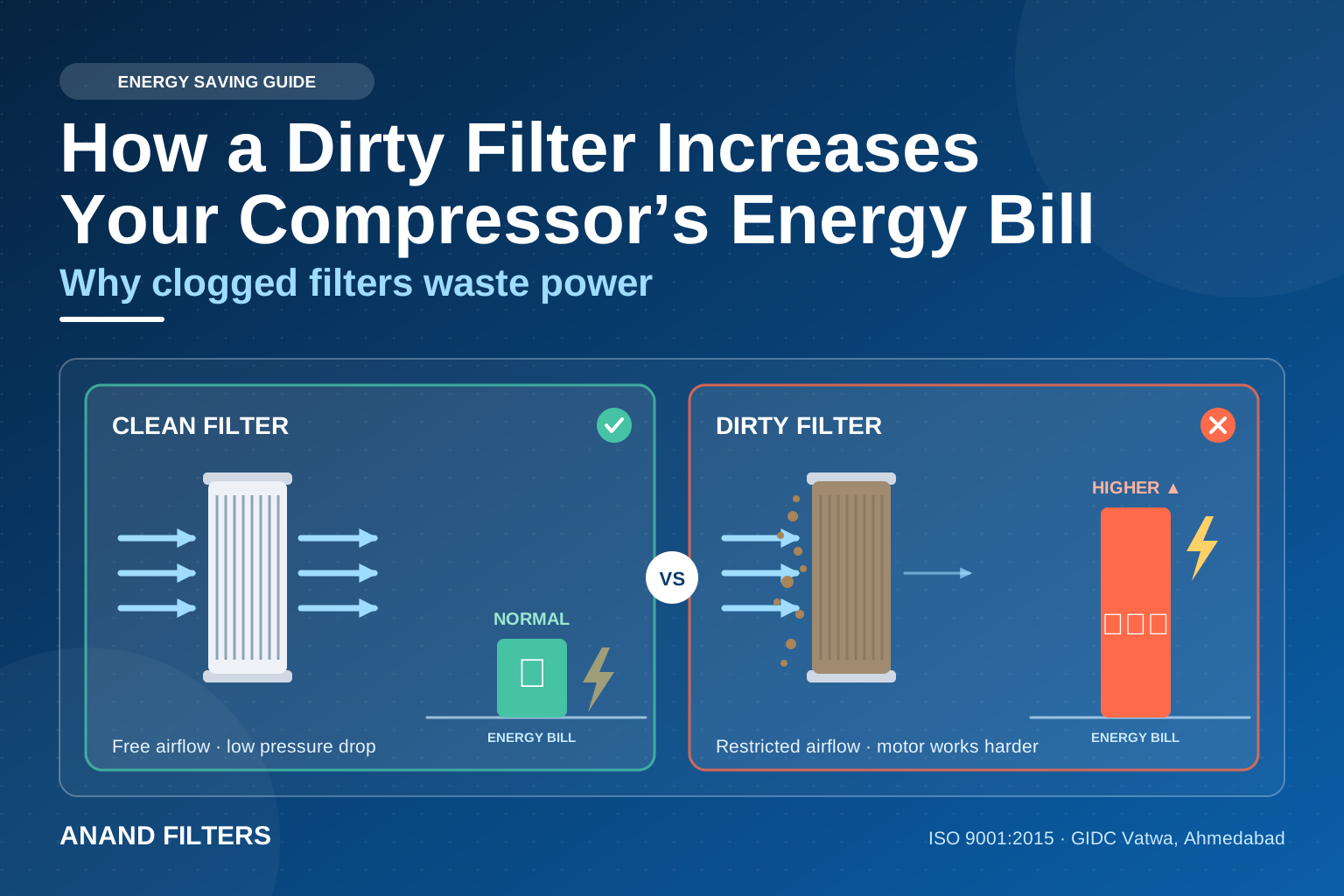
How a Dirty Filter Increases Your Compressor’s Energy Bill
A dirty compressor filter never appears as a line item on your electricity bill, yet you pay for it every month. As an element clogs, air meets more resistance, the pressure drop rises and the compressor uses more power to deliver the same air. The right air compressor filter, changed at the right time, is one of the cheapest ways to protect compressor efficiency. This guide shows how much a dirty filter can cost, with a worked example in rupees, and how to catch it early.
Quick answer: a dirty compressor filter adds resistance, which creates pressure drop. The compressor then works harder, or runs at a higher pressure to compensate. A common rule of thumb is about 1% more energy for every 2 psi of added pressure drop, plus a higher risk of overheating and wear.
Table of Contents
How a Dirty Compressor Filter Wastes Energy
A filter works by trapping dust. As the element loads up, air has to squeeze through less open area, and that resistance costs energy. On the intake side, the compressor has to pull harder to draw in air, so it delivers less for the same power. Further along, a loaded separator or inline filter leaves lower pressure at the plant than the compressor produces. Operators often respond by raising the pressure setting, which uses even more energy.
The electricity bill is not the only cost:
- Overheating: a clogged intake filter can push a screw compressor into high-temperature alarms.
- Lower output: less air for the same running hours.
- Wear and contamination: a damaged or bypassed filter lets dust into the air end and the oil.
What Is Pressure Drop?
Pressure drop is the difference between the pressure before and after a filter, measured in psi, bar or kPa. A differential pressure gauge reads it directly. A new element starts low and the reading rises as dust builds up. For reference, 1 bar is about 14.5 psi. Because compressor efficiency depends on how little energy is spent pushing air through filters and pipework, pressure drop is the number to watch.
Dirty Compressor Filter Energy Loss: The Numbers
A widely used rule of thumb says each 2 psi (about 0.14 bar) of added pressure raises compressor energy use by roughly 1%. The table applies it to common values.
| Extra pressure drop | Approximate extra energy |
|---|---|
| 2 psi (0.14 bar) | About 1% |
| 5 psi (0.34 bar) | About 2.5% |
| 10 psi (0.69 bar) | About 5% |
| 14.5 psi (1 bar) | About 7% |
Treat these as estimates. Actual figures vary with load, compressor type and controls, so confirm them against your own power readings. Fixed-speed and variable-speed machines also respond differently, so treat the result as a guide, not a guarantee.
What It Costs a Plant
Use this formula: kW × running hours × tariff × (extra psi ÷ 2) × 1%.
Take an illustrative 75 kW compressor running 6,000 hours a year at ₹8 per kWh. Its annual energy cost is about ₹36,00,000. If dirty filters add 10 psi of extra pressure drop, that is roughly 5% more energy, or about ₹1,80,000 every year. Replace the filters on time and most of that cost disappears. Use your own kW, hours and tariff to get your figure, then compare it with the price of a replacement element.
Where Filters Add Pressure Drop
An air compressor filter is not one part. Four different filters can add resistance, and each shows up differently:
| Filter | Where it sits | Effect when clogged | What to monitor |
|---|---|---|---|
| Intake filter | Compressor inlet | Less air drawn in, more effort, overheating risk | Restriction indicator or gauge |
| Oil filter | Oil circuit | Poor oil flow, higher oil temperature | Oil temperature, bypass indicator |
| Air-oil separator | After the air end | Higher back-pressure, more motor load, oil carryover | Pressure difference across the element |
| Inline filters | Downstream air line | Lower pressure at the point of use | Gauge on each housing |
As a rough guide from energy-efficiency guidance, a new intake filter should add only a few psi, and total losses from receiver to point of use should stay well below 5% of discharge pressure. For a full comparison, read our guide to the types of compressor filters. You can also browse our compressor air filters and air-oil separators.
How to Measure Pressure Drop
Fit a differential pressure gauge or indicator across each filter housing, and record the reading when the element is new. Then check it weekly and log the values in your maintenance sheet, so trends are easy to spot. A rising reading, higher power draw for the same output or a tripped restriction indicator all point to a dirty compressor filter. For visual and performance clues, see air compressor air filter replacement signs, and for separators, the air-oil separator filter replacement guide.
When to Replace
Replace on pressure drop, not only on dates. The table gives a starting point, but always follow your service manual and the filter data sheet.
| Filter | Replace when | Baseline |
|---|---|---|
| Intake filter | Indicator trips or pressure drop reaches the data sheet limit | Many suppliers quote about 2,000 hours at minimum; sooner in dusty sites |
| Oil filter | At each oil service, or when the bypass indicator shows | Per service manual |
| Air-oil separator | Pressure difference rises or oil appears downstream | Per service manual |
| Inline filters | Gauge reaches its limit | Per data sheet |
Planned changes cost far less than wasted energy and unplanned stops. Our guides on regularly replacing filters in compressors and when your compressor needs servicing explain how to plan it.
How to Keep Pressure Drop Low
- Size for the airflow. Pick elements rated for your full flow, with low initial resistance and good dust-holding capacity.
- Avoid poor-quality elements. Weak media or poor sealing can mean a higher drop even when new. Use our genuine screw compressor spares buyer’s checklist.
- Protect in dusty plants. A prefilter extends the life of the main element, and heavy dust or monsoon humidity loads filters faster. See industrial filter maintenance during the monsoon.
- Never clean disposable elements. Blowing air through them damages the media.
Do not raise the pressure to hide a dirty filter. A higher setting uses more energy and increases air leakage. Fix the filter instead.
Frequently Asked Questions
How much energy does a dirty compressor filter waste?
A common rule of thumb is about 1% more energy for every 2 psi of added pressure drop. A badly clogged filter can therefore add several percent to your power cost.
What is an acceptable pressure drop across a compressor filter?
A new filter should add only a few psi. Replace it when the differential pressure reaches the limit on its data sheet, rather than waiting for symptoms.
How often should a compressor filter be changed?
Follow your service manual. Many suppliers quote at least 2,000 running hours for air and oil filters, and sooner in dusty plants or when the indicator trips.
Does a dirty air filter make a compressor use more electricity?
Yes. A clogged filter adds resistance, so the compressor works harder for the same output, which raises power use and can cause overheating.
What causes pressure drop in a compressed air system?
Resistance from filters, separators, dryers, pipes, valves and fittings. Dirty or undersized filters are among the most common and easiest causes to fix.
Can a dirty filter damage a compressor?
Yes. A clogged intake filter can overheat a compressor, and a damaged or bypassed filter lets dust in, which wears the air end and contaminates the oil.
A dirty compressor filter quietly raises pressure drop, energy use and wear. Measure the drop, replace on clear triggers and choose elements with low resistance. Anand Filters: Industrial Filter Manufacturers supplies compressor air filters, air-oil separators and related elements to help you keep compressor efficiency high.
Need the right filter for your compressor? Share your model and running hours, and our team will help you choose. Browse our compressor filter range or contact us for a quotation.